Standing Out In A World Of Sameness
December 22, 2025

Hosted By
 Dan Sullivan
 Jeffrey Madoff
Are you letting data define your story or are you doubling down on what makes you truly exceptional? Dan Sullivan and Jeffrey Madoff challenge the idea that AI and metrics are enough, and show why entrepreneurs who cast instead of hire, elevate standout performances, and compete on impact, not price, build the most memorable and valuable companies.
Show Notes:
Casting the right person for a role starts with the story of what they actually do, how their team creates value, and how that supports the company’s bigger narrative.
Data can describe performance, but it can’t replace the human story that gives work meaning, direction, and context.
Computers and AI are designed to find what’s the same, which makes them great at patterns but weak at capturing what’s truly exceptional.
Storytelling focuses on the one person, one result, or one moment that stands out from everything else.
When organizations cut costs by standardizing everything, they usually strip out the exceptional people, offers, and experiences that make them memorable.
Entrepreneurs are at their best when they continually differentiate themselves, their offers, and their clients instead of trying to fit into industry averages.
The real question around AI isn’t, “Is it good or bad” but rather, “In what context am I using it, and does it amplify or erase what’s unique about us?”
If your company looks and sounds like everyone else, the only thing you can compete on is price.
Impact is what makes an experience unforgettable, and that memorability is what sets you apart in a crowded market.
Nothing changes in your business story until you take action and create new experiences worth talking about.
When you operate from your exceptional strengths, competitors become background noise instead of a threat.
Many entrepreneurs don’t fully step into their unique story until midlife, when experience and clarity finally catch up with ambition.
Resources:
Casting Not Hiring by Dan Sullivan and Jeffrey Madoff
Always More Ambitious by Dan Sullivan
Your Business Is A Theater Production: Your Back Stage Shouldn’t Show On The Front Stage
Episode Transcript
Jeffrey Madoff: This is Jeffrey Madoff, and welcome to our podcast called Anything and Everything with my partner, Dan Sullivan.
Dan Sullivan: Jeff, we're writing a book called Casting Not Hiring, and one of the main themes in this book is to actually not hire people for jobs, but actually cast people for roles. And this is what's really important about that. That's the way that theatrical enterprises are put together. But the big thing about the role is the role is connected very much to the story of what that person's activity is, what their team does, and also what the company does. It's about storytelling. And our feeling right now is that there's a movement that all of business is just about data. And what we're doing is we're saying, yeah, but data just leaves out the story. So that's what I'd like to talk about.
Jeffrey Madoff: Yeah, and you referenced, before we started recording, a book you had read by Angus Fletcher, which inspired today's wandering through the intellectual forest. And tell us a little bit about that. Give us the context for this.
Dan Sullivan: Yeah, his main point is that data, the way computers work and the way AI works, identifies everything that is the same. It has a thing about making everything the same and giving you a flat account of something, whereas storytelling goes after the exceptional. And Jeff, you've been in theater and around theater and either in live performance or recorded performance for the last 50 years. And you know that a great script has got exceptional stories. A great script talks about exceptional plots, exceptional scenes, exceptional, it's all about exceptional, and that the storytelling is what people are really interested in. They're not interested in the everyday. They're not interested in the commoditized version of things. They're interested in exceptional, exceptional stories, exceptional plots. And you've also been connected with the marketing world for 50 years. And you know that anytime that companies, corporations, want to lower the cost of things, they take the exceptional things out and make the most commoditized version of what they can do. That doesn't really depend upon exceptional people or exceptional offers. I just found it very intriguing and that everything that I'm interested in coaching entrepreneurs is, what's the exceptional thing they do? Who are the exceptional clients that they're working? So this whole concept that stories are about exceptional things, data is really about what everybody else is doing.
Jeffrey Madoff: And it's quantifying. But without context, it doesn't mean anything. That is not even information until it's somehow applied and translated into something useful. So, you know, it's funny, when you're using the word exceptional, I remember when I was in school, and I finished the assignment first, and so I said to the teacher, I'm done, can I leave? And she said, well, do you think you're the exception? I said, yeah, I'm the one that's done. So yeah, it was like I was supposed to be embarrassed that I considered myself the exception. Do you want to be the exception to the rule? Also, in good things, yeah. I don't want to die at old age at 11 years old. That would be another kind of exception. But exceptional, by definition, is except for others. How would you define exception?
Dan Sullivan: Well, it's one of the kind in any setting. There's everything else and then there's the one that's, you know, different. It's different. It's got all sorts of characteristics or qualities that are different. You know, I've been an entrepreneur for 51 years and, you know, you're always differentiating yourself. You're always coming up with the thing that differentiates you. And that's how you operate in the marketplace. When I first started, I called myself an entrepreneurial coach. Well, there was no such thing as an entrepreneurial coach. And that was a good thing and that was a bad thing. It was a good thing is that nobody else was out delivering the message that I was delivering. But nobody really knew what entrepreneurism was and nobody knew what coaching was. You know, I mean, coaching was something you did in sports. Coaching is something you do in the arts and entertainment. They have coaches. They always had coaches. But the whole notion of an entrepreneurial coach was unique.
So I was forced to explain how it was different from consulting, how it was different from management. It was a very, very different sort of thing where I'm looking for the person who is an entrepreneur who has exceptional skills and exceptional ambitions. And then I'm going to work with him and give him thinking structures and processes that allow him to maintain his full focus on everything that's exceptional about what he or she is doing. And so that became the way that you did it. My sense is that with AI advancing by the week, where people are writing now, writing reports, they're now writing accounts of things and everything else, but they're basically using the structure and the process that everybody uses.
Jeffrey Madoff: Well, it's interesting because what AI can do is quite fascinating. There's an awful lot it can't do or can't do yet. And I never believe in the panacea that this solves all problems and will make everything better. It all depends. It's another tool and how do you use the tool and so on. In doing research, what I find interesting is that every quote, every statistic, everything that is quantified numerically, before I consider it, I vet it. And you get a lot of wrong information, a lot, you know, using AI. And there's still really big gaps. And I think back to earlier examples of what I call AI, which was, you know, something that seemed to be written by a human, but wasn't. And I think of greeting cards. When things started getting a little less personal, and you know, you got a machine writing out, thinking of you, hope you are doing better, get well soon, whatever. And then you just sign your name because you agree with the sentiment. But in a way, that was a form of AI, as spellchecking is an early form of AI, which, you know, if the word is spelled correctly, even if it's used incorrectly, it doesn't catch it. And to me, that's part of the whole big picture, which is context. And, you know, in what context are you using these things and how? And I think that the sorting and information retrieval is great, but you certainly cannot assume that what you get back on face value is correct.
Dan Sullivan: Yeah. I'd like you to take a look at it from the standpoint of differentiating yourself, because in the marketplace, if you're the same as everybody else, then you can only compete on price.
Jeffrey Madoff: That's right.
Dan Sullivan: I'm a fifth child in my family. I had to learn to differentiate right from the beginning.
Jeffrey Madoff: What, did you all look alike?
Dan Sullivan: To my parents, yes.
Jeffrey Madoff: Which one's Dan?
Dan Sullivan: Yeah. My brothers' names were Joe, Bill, and Ed. And when my mother would call me, she'd say, Joe, Bill, Ed, Dan. I just wait because I'm number four. I'm the fourth boy. I'm the fourth boy. What I'm saying here is that in a competitive marketplace, you want to be exceptional and try to stay away from price as being the thing that you're exceptional with. You know, because you can't really be exceptional by charging more. You can only be exceptional by charging less. And delivering more. Delivering more.
Jeffrey Madoff: Right. Yeah. I mean, you know, exceed the expectation. That makes you exceptional.
Dan Sullivan: Yeah.
Jeffrey Madoff: And I guess it's interesting. On one hand, I guess a synonym for exceptional is unique. But something can be unique and not good.
Dan Sullivan: But yeah, I think that … well, I'm just talking about good here. I'm not talking about bad behavior. I'm just talking about things that stand out, you know, in a positive way, things that stand out in a memorable way.
Jeffrey Madoff: You know, I've mentioned before to you the series by Howard Silber called The Power of Film, which is all about stories and relationships and all that kind of thing, which is a fascinating series. And what makes it fascinating is it talks about what makes something memorable, which again is something that is exceptional. You know, what makes it memorable? For instance, in the world of film and theater, there are shows that may entertain you, you enjoy when you see it. And by the time you five minutes after you left the theater, you can't remember one thing that happened because nothing was exceptional. It was just a fine experience. So it was okay. And then you think of those things that really have an impact. And I think impact is what makes something memorable. And I think in storytelling, that impact is emotional. And creating an emotional impact, I think you have to also understand what's at stake for the characters. And the interesting thing is, and I guess movies, books, on some level, good ones anyhow, are mirrors of our time, but the great ones last and last, the exceptional ones last and last.
So there's many things that they may do really well financially, they're not memorable, and they don't last. And then there are those things that last generation to generation. because they're memorable, which made them exceptional. And I think that's the main thing in storytelling, is that when you establish that emotional connection, when you care about that character, when what happens to them by proxy happens to you while you're observing it and you're feeling and have internalized those feelings, that's exceptional. And not easy to do, you know, but I think it's also a truism in business. You know, if people are happy with their purchase, if somehow it made their life better and they tell their friends about it, you gotta see X or you gotta try X or whatever. So I think that tying together the marketing and the storytelling aspect, they're kind of one in the same, and seeking, I don't know if you can seek being exceptional. I don't know, I wonder, are we, I feel like I'm hardwired to try to be really good in whatever it is I do. And, you know, in our …
Dan Sullivan: That's exceptional.
Jeffrey Madoff: And I mean, that's, you know, and I see that in my kids.
Dan Sullivan: No, no, I'm saying that that's exceptional.
Jeffrey Madoff: And so explain what you mean.
Dan Sullivan: Well, you know, I would say we've taken a look at just how many entrepreneurs out there that we're looking for. Well, first of all, you know, I think what we came up with, it's about one out of 2,000, one out of 2,000. If I'm with 2,000 entrepreneurs and I'm sending a message to them, there's one that's really, really going to be looking for what it is that we're creating. This is a whole new period for us. And in other words, we've had various messages in the ‘70s, the ‘80s, the ‘90s. But here in the 2020s, what I'm finding is that the word that really, really gets people's attention is we make ambitious entrepreneurs more ambitious. And the reason why that's exceptional as a line is that ambition is not something that's talked about in polite conversations. It's not talked about in polite society. People say, you know, my ambition is getting so big, okay? And the reason is that there's not an understanding of what ambition is.
My belief is that ambition is a capability that can be grown. A lot of people think the ambition is a gas tank that you're given at birth and it's filled up. And there's very small gas tanks and there's really big gas tanks. And it's an uncomfortable subject to talk about someone with a really big ambition gas tank. And because there's complete inequality about ambition, the way people treat it. There's people who are very, very ambitious. So the thing that put me on this is that one of the things that are experienced entrepreneurs and Strategic Coach, for example, they've been there for five years or six years, they're in the Program. And they said, you know, Strategic Coach is the only place where I can be unambiguously ambitious. I can talk about my wins, I can talk about my successes, I can talk about my goals, and everybody in the room, nobody's jealous, nobody's jealous, nobody's envious of what I'm doing because we're all acquiring capabilities here that from one quarter to the next, the results are better. We have a better team. We're getting higher quality clients and customers. The usefulness of what we're offering in the marketplace keeps getting better. And that comes from the ability to talk about our ambitions.
And I found that since I got on this. The reason I was when I was in Nashville last year, and you were there too, somebody came up to me and said, you seem really ambitious at 80. And I said, yeah, I'm very, very ambitious at 80. And I told him projects that we're working on and everything. And he said, well, when you're 90, what's your ambition going to be when you're 90? And I said, my ambition when I'm 90 is to be more ambitious. And he said, well, ambitious about what? And I said, whatever's going on when I'm 90. And that just stayed with me because it was a good way of talking about it. My ambition is to be more ambitious because it's a capability of being able to be successful with whatever's going on in a better way than you were in the past.
Jeffrey Madoff: It's very interesting. I think that there's ambition. And I'm not sure I think of it as a capability. I think of it as a frame of mind, that if you are ambitious, it means that you want to achieve, and I think achievement is a huge part of ambition, because there's all kinds of people that profess to have ambition. I want to do this, I want to do that, whatever it is, you know, I want to grow my income to eight figures, I want to, whatever it is, there's, you know, there's all kinds of ambition, and then there's achievement. And, you know, how do you achieve your goals because that's what your ambition is. And I think a lot of it in every business has to do with, how do you achieve? Because a lot of people don't act on their ambitions. And I guess the reason I say that I don't see it as much as a capability. I think the capability is how to achieve those ambitions because that gets into a whole other area because it's quite an interesting topic. Ambition in and of itself, I want to do X. Well, if you don't do anything, if you don't engage in activities that can help you achieve what you want.
Dan Sullivan: You're talking about the people handling ambition in the wrong way, or not at all. I'm talking about people who have been ambitious from childhood. Okay. And they've developed capability, other capabilities, because their main capability is ambition. and then they have to learn how to do this, and then they have to put this person in place, and then they have to use that, which are all new capabilities. My sense is that ambition is the platform itself in which all other capabilities grow. And I guess I would say that … and the capabilities are what allow you to achieve. It's the new capabilities that allow you to achieve.
Jeffrey Madoff: Yeah, it's interesting because I think that ambition, it's funny, I guess it's how one defines ambition. If ambition is, this is what I want to achieve, and if along with that, no matter what it takes. Okay, so if it's no matter what it takes and taking it to a certain level, if that sacrifices your health, your family, all of those kinds of things, I guess there's that phrase blind ambition.
Dan Sullivan: What I find is that the people who've talked about these things are not as ambitious as other people. I find ambitious people just go for it. They don't explain what they're doing. They're just saying, now I want to achieve this, now I want to achieve that, you know. And I think that there's a spectator version of ambition where you're watching other people and you're saying, well, I wouldn't want to be like that because of this, I wouldn't want to be. But they themselves are not really, they're arguing, they're not taking action.
Jeffrey Madoff: Yeah, I mean, I think that I'm ambitious. I think I'm quite ambitious, but I also am mindful of what the costs can be. Now, does that stop me? I don't find any of the things that I've done have heinous costs. You know, there are things that I want to do, I'm supported by my family in doing them and so on. But I do think ambition needs to be anchored to certain things. And what I mean by that is, you know, what's the impact of me doing X? Could this be a negative impact on something I value very much, for instance, like my family? Because all of a sudden, my ambition is driving me to a place where I'm creating more and more and more distance.
Dan Sullivan: Well, what if I just express that that type of ambition, you include your form of ambition and now you've become ambitious, is making sure that you include in your ambition all the things that mean a great deal to you. It's not ambition that causes bad things. It's a person that doesn't really care about anything except themselves, but they're ambitious. I'm just saying it's like electricity. Nothing moves without the ambition. Nothing moves without the electricity.
Jeffrey Madoff: No, I think you've brought up an important discussion because that's part of the ambition.
Dan Sullivan: Yeah.
Jeffrey Madoff: I agree. I think that brings the two together in a way, because I think there's lots of people that I've met, and I'm sure you have too, that are on the face of it very ambitious, but since they've done no examination at all personally, they aren't aware of any consequences of their actions until the trouble gets too difficult to ignore. And I think that that happens. I mean, I think we've seen that in ..
Dan Sullivan: But since you had that first meeting, that first interview with Lloyd Price, and you did the documentary film on him, all of a sudden your ambition moved—I'm going to take this story and turn it into a musical production with Lloyd's agreement.
Jeffrey Madoff: Correct.
Dan Sullivan: You wouldn't have done it if he didn't agree to do it.
Jeffrey Madoff: That's right. Nor could I have in terms of his life rights, but that's right.
Dan Sullivan: Yeah, but from the moment that you brought it up as a topic and, you know, seven, eight years ago, I don't know how long ago, the actual date when you decided that you're going to do this, I think it's been pure ambition that's allowed you to put together the back stage team, to put together the front stage teams, to get the funding. Your ambition is allowing you to achieve all these other things on the way to it being on the big stage, you know, the highest stage it can be, that's ambition. And I would say I think you're exceptional in doing that. One, it's the first time you've done it in this particular form, live musical on stage, you know, Broadway musical, essentially the general category. What I'm saying is everything else you've learned over the last seven, eight years about how you put together a musical, how you get the funding together and everything like that, those abilities, those extra capabilities have only been developed because of the capability of ambition, of you wanting to see this on stage.
Jeffrey Madoff: Is it ambition or is it desire? And what's the difference between ambition and desire?
Dan Sullivan: Well, because ambition immediately triggers action.
Jeffrey Madoff: I could argue that also the desire.
Dan Sullivan: Yeah, well, it does. I want that.
Jeffrey Madoff: I want that. I want that to happen. And the only way to get that to happen is to take action. I mean, we all know the filing cabinet's full of ideas that never were actualized. And so I think …
Dan Sullivan: But that wasn't ambition. It was just an idea.
Jeffrey Madoff: Uh-huh. No, you're saying that there's a certain alchemy that happens. And ambition … ambition becomes the catapult, if you will, for the actions, but you gotta load that catapult.
Dan Sullivan: Yeah, and my sense is that you can be born in the wrong circumstances. You can be surrounded by the wrong people. You have the ambition, but you just can't take action on it because there's too much pushback. I mean, you couldn't do what you're doing right now living back in Akron.
Jeffrey Madoff: Right.
Dan Sullivan: I guarantee you, I couldn't be doing it living in Norwalk. in Ohio. As part of our ambition, we had to get ourselves in the right place, surrounded by the right people, you know, where this ambition would be supported in a major way.
Jeffrey Madoff: Yeah, I mean, if we define desire as, I don't know what the degree of difference is, a compelling need to get or do something. You have the desire and maybe that's not really any different than ambition. Maybe they're somewhat synonymous because …
Dan Sullivan: Well, I think ambition seems to be broader. I mean, if you take the definition of desire in the dictionary and you put ambition, I think that they're described in very, very different ways. I don't know. I haven't done it. I haven't done it.
I haven't either.
Dan Sullivan: But I will. I will as a result of this. I have an ambition for you to understand ambition the way that I'm understanding it.
Jeffrey Madoff: And I have the desire. Yeah, I think it's an interesting question because, well, for instance, I think that part of a positive outcome among Coach clients is they learn how to act on their ambition, eliminate the things that distract from it, and help them develop through your thinking tools ways to achieve what they want. And sometimes I think our ambitions, what's the origin story of an ambition? Is the origin story—I'll fabricate something really quickly. Parents, this is a fictional family now, I'm gonna say. The parents are always arguing. But when that child can somehow get their attention and do something that gets them laughing and diffuses the anger, that becomes a capability they've developed. It protects them, so it's self-protection. It protects their ambition too. Or creates the ambition because it creates a safer place for them to be emotionally. I think of Jonathan Winters. I don't know if his initial desire wasn't necessarily to become a comedian, but because he was locked in a closet by his parents, he invented these playmates, which were all these characters he created that helped him deal with the pain. And I think he was so exceptional in his improvisational activities, which he was doing for emotional protection when locked in the closet.
Dan Sullivan: Part of the reason.
Jeffrey Madoff: And what's the other part?
Dan Sullivan: Well, my feeling is you're essentially defining it as a response to negativity.
Jeffrey Madoff: No, I think it can be, but that's not.
Dan Sullivan: Okay. So you're just giving an example.
Jeffrey Madoff: Yes, that's right. I'm giving an example because it can also come from a very positive place. You can get the reinforcement. People like your stories. They laugh at your jokes. Can you put this into a context that allows me to further develop those capabilities in terms of writing and sharpening dialogue, all those kinds of things, because I love the response I get as a result. And, you know, so I think that dealing with those wants and desires and the ambition it takes to achieve those things is a very interesting dynamic. Look at how that is.
Dan Sullivan: Here's something, the reason why I think that we've created something exceptional, because that's the kickoff thought of this particular podcast, is that you don't want to be bothered by competition. I mean, one of the things I find among the entrepreneurs, you know, there's this thing that you just see it talked about. You see it talked about, you know, that what really creates progress, what really creates improvements in society, is the competition among people. And I said, but I've been coaching entrepreneurs for 51 years and they want to be free of competition. Competition just takes a lot of work. One, you have to pay attention to what somebody else is doing, you know, and everything. So one phrase that we use is get yourself to a competition-free situation in the marketplace. Okay, and what does that require? Well, you're doing something that's just exceptional that nobody can even figure out how you're doing it. I would say that was the great ambition that entrepreneurs have, is to be doing something competition-free because it's so exceptional. The competition actually wants to be your customers because they'd like to know how you're doing what you're doing. Okay.
Jeffrey Madoff: Yeah, I think that's true, but I also think that there is a time window on that. And what I mean by that is you always have to keep iterating and moving forward because the competition at some point is going to, once you've demonstrated that there is a viable marketplace, competition then starts running to that waterhole to see what it is. And I agree with you in that, for instance, with Ralph Lauren, who was a client for 36, 37 years or something, there were always people after that account, because it was such a fantastic account. And my desire to always make myself relevant and bring ideas to the table, and because I had Ralph's ear, I had a very strong protection and ally in doing that, which is really great. When I started out, I was one of the first people doing videos and fashion shows. That just wasn't happening before. Became a significant business, actually a significant business that I walked away from, because it was no longer interesting to me. Because I was recording something, but I didn't have, I wanted more creative freedom.
Dan Sullivan: But it's … I don't think you walked away from it. It was just a learning stage of developing.
Jeffrey Madoff: Well, that's right. That's right.
Dan Sullivan: You didn't walk away from it. You walked towards something even bigger.
Jeffrey Madoff: Well, that's right. That's right. And could I have tried to set up a division of Madoff Productions that just did fashion shows and bring somebody else in to run that and so on? Maybe, but I didn't have any interest in that. You know, and … you know, you changed your business from Strategic Coach to now having your Free Zone, which is a higher cost of entry. But what it did is actually enhance your business, you know, because you created another tier of achievement and possible capability for the clients that they felt it was worth the money to grow their business in this way. You created another unique platform for your own business.
Dan Sullivan: The interesting thing though, is it was the clients who created the higher level. We have two levels. We have the Signature level, which is probably better than almost any other coaching company, but it just shows you how to arrange your days, get a handle on how long you're going to be living as an active entrepreneur. That's the first thing that they do. They learn what their Unique Ability is so that they can remove all activities that aren't unique to them, that other people can do these activities. That's all in the first year. And then they begin to notice that some of them in the room are running ahead, you know, that they're multiplying much more quickly than everybody else in the room. So I said, okay, let's now create another part of the Program for just those people who are running ahead. And it's called the 10x Program. Because we're getting proof that from where they started, they're now 10x of where they were. Okay, well, let's take everybody who's 10x, and let's put them in a group by themselves. And then I saw a whole bunch of them were starting to collaborate with other companies in the marketplace where they were taking someone of equal capability in the marketplace and putting the two of them together to create a Free Zone. And so it's actually just constantly responding to the best people in the Program with new ideas. And at a certain point you say it makes sense just to create a separate level.
Jeffrey Madoff: Right, which was an increased capability because you targeted a specific audience.
Dan Sullivan: Yeah, yeah, yeah. They don't come in at that level. I mean, there's people out there who, from an accomplishment standpoint, you know, they're talented, they're successful, but they don't know the basics of the Program, so they have to go through the basics of the Program. And they have to do one year at the basic level, they have to do one year at the intermediate level before they can go to the Free Zone level. It's like Boy Scouts, tenderfoot, second class, first class, you know?
Jeffrey Madoff: Yeah, or undergraduate and graduate school or whatever, but yeah. You know, I always thought that competition never concerned me. You know, I never thought about, I can't do that as well, or I can't create an offering that would be good. Where I found competition, interestingly, is because I was very early in this business, in terms of like videoing shows and that sort of thing, bad companies were the competition. And by competition, I don't mean directly with me. I mean, for this kind of a business period, because when people did crappy work, then they would say, well, video doesn't work for us. And I confronted that a lot very early on, when other companies were jumping into the fray, but they didn't know what they were doing. And they get hired, and they waste several thousand dollars of the client's money. They don't deliver on the promise. And the client's conclusion is, video didn't work for us. No, it was the wrong video, approached wrong, in the wrong framework. So you got a bad outcome, but that's, you know, the old baby with the bathwater, you don't throw that out.
So I think it's interesting, but I think good companies, it's like when good athletes are playing against each other, hopefully everybody ups their game. So are more of that school, that good companies make it all better, because the bad companies are the ones that oftentimes kill opportunity because people get gun-shy because it didn't work and they aren't willing to take the risk again. So I think that a lot of companies focus on competition, but what they should really be looking at is, is this competition because they're doing really good work and something I should pay attention to, or is there doing really bad work? And as a result, they're shrinking the market because everybody's getting gun shy because it's not working. It's not benefiting the business. And that's just because they hired the wrong company. They were doing it wrong. But in those early stages of any enterprise, that can be the problem. And then there's the companies of course that blow it, like Blackberry, which could have been more successful than the iPhone, but they were paying attention to the wrong things. And so I think it's really interesting because your business was built on the iteration of your perception of the client's needs and the opportunities that that created for Strategic Coach. Would you say that's accurate?
Dan Sullivan: I would say I'm aware of their needs and I'm aware of their wants because wants are different from needs.
Jeffrey Madoff: Yeah. There's that other phrase, which I have been humorously accused of doing is, you know, sell them on their wants and deliver all their needs. How do you draw that distinction?
Dan Sullivan: Yeah, I would say, and I'll give you a specific example. I heard that phrase from Joe Polish, so I don't know if it's Joe's or somebody else's. But what they want right off the bat is more time. All their time is taken up and they can't work harder, they can't work longer. Okay, so if they could get 20% of their time back, at the end of the first year, the money just rolls in as a result of that. And one of the things that we've noticed that money is really a big deal probably until halfway through the second year. And then they stopped talking about money. Hardly anybody talks about money after a year and a half because the money has become a system now and they know how to increase the money. You know, they were lacking their own thinking time. They were lacking the capabilities around them. You know, I always say there's three stages. You make it up, and then you make it real, and then you make it recur. All the money's in the recurring.
Jeffrey Madoff: Absolutely.
Dan Sullivan: And that takes different skills besides your own. Like, I'm a great make-it-up person, but I'm not a great make-it-real person, so I have a whole bunch of team members, artists and technicians and everything, that can take what I create and they can make it real in terms of workshop materials, workshop settings, and everything like that. Printing, video, everything. And then when it really starts rolling in, we can get other coaches besides me to do it. So we have 16 coaches now. They're the ones who make it recur. It allows me to spend more and more time now making up new things than I did at the beginning.
Jeffrey Madoff: Yeah, I think that the incredibly important aspect of that triad you just set up is recurring, because if you don't get recurring business, you're not gonna stay in business. And my approach was always like, with Ralph or with Victoria's Secret or other clients was, never give them a reason to go someplace else. Because I want them to feel like—it's funny, it's like we're having our apartment renovated and the contractor was telling me how busy he was, you know, that he has all these clients and these, you know, number of jobs going on at the same time.
Dan Sullivan: And that's … like you don't really want to know that.
Jeffrey Madoff: That's right. That's right. I said, you should understand one very fundamental thing. And he said, what's that? I'm the only one of your clients I care about. I'm not impressed that you have a lot of clients. I want my work done. And I certainly don't want that to be an excuse why things aren't happening. You know, it's interesting, you know, taking it back to the idea of ambition, achievement, desire. These are also states of being, you know, because people's ambitions are manifest through marketplace response on the outside. And on the inside, it's their desire to accomplish something. I mean, I want the play to be successful financially. But I'm telling the story I want to tell with people I want to tell it with, and I will not compromise on what that is, but I will make it better the longer I'm involved with it. And it's been both an experiment and a confirmation where my ambition and desire have, as you said, increased my capabilities in terms of how to best approach that business and to hopefully be offering something that is unique and something that people will pay for.
Dan Sullivan: Oh yeah, yeah. No, I mean, I've been along for the ride since you started and the level of knowledge and skill that you have today compared to six or seven years ago is exponentially greater.
Jeffrey Madoff: It is. And one of the reasons that I can say that with some confidence is as we have these meetings, as decisions are being made, that process is faster or I feel more secure about the decisions that we're making because I understand all the different factors that lead to that particular line of action and all of that. I think it's a really interesting thought process, and I think an important one, to understand one's ambitions, how to achieve what those ambitions are, and how to place things in a context so that you understand. Because I think it also helps you understand how you want to do something. Not just that you want to do it, but how do you do that?
Dan Sullivan: Now, I'll go back to something I started with. When it comes to the subject of ambition, nobody wants to talk about it. They'll talk about achievement, they'll talk about this, they don't wanna talk about ambition.
Jeffrey Madoff: It's funny, I haven't hit that kind of a wall.
Dan Sullivan: I'm not saying you.
Jeffrey Madoff: No, I understand.
Dan Sullivan: But this is the first time since we've been involved in, you know, Babs and I have been involved in your theater project. And it's the first time since we started doing the podcast that we're talking about the word ambition.
Jeffrey Madoff: Mm-hmm, yeah.
Dan Sullivan: No, I'm saying that's generally true in society. Nobody talks about ambition. And I said, so if you have an entire ecosystem and environment where you just talk about ambition, that's exceptional. So that's really what I'm saying. I go for the things that nobody wants to talk about in polite society. And I say, let's just talk about it. Let's get to the bottom of this ambition.
Jeffrey Madoff: Yeah, I don't know why that would be a negative, because it requires that, as using your same metaphor, the gas tank, in order to achieve those ambitions, you've got to have that drive.
Dan Sullivan: Yeah, but it's actually a visual picture that I can see when they talk about ambition. They say, well, he's got a bigger tank than I do. I have a bigger tank than this person does. But the problem with it, everybody knows, no matter how big your tank or small your tank, it runs out at around 60 years old. After that, you got to start planning for what's your life going to be when you don't have any more ambition.
Jeffrey Madoff: Which I think something we both share is that's death.
Dan Sullivan: Well, we're not looking at it as a gas tank. We're looking at it as a capability.
Jeffrey Madoff: Yes. Yeah. And it's nothing. I think that, you know, the old phrase, having a reason to get up in the morning, what I tend to call it is engagement, which is what I think is so important that I'm doing things that I am engaged in. And with that, I mean, I get the same thing. Why did you take on that? Isn't that an awfully big project to be taking on at your age? You know, no, because I don't golf, I don't fish, I don't play cards. And no, what better than, you know, there's something I want us to talk about maybe in our next one, but it's interesting with entrepreneurs because the exceptional stories are the people that make it very big, very young, but most entrepreneurs don't manifest until they're in their middle age, you know, because you got to learn what you're doing. Sometimes you're just lucky and you step in it.
Dan Sullivan: Warren Buffett is 94, 95 and all the success was after 65. That's when people really knew Warren Buffett was after 65.
Jeffrey Madoff: Yeah, it's so interesting, but there's a skewed vision that entrepreneurship is a young person's business, but you can actually be much more efficient and successful after you've had enough experience to know what you're doing and the network or contacts that you've established along the way and all of that. I mean, on my next play, I know who's getting the first calls. These are people that I've met through this journey who I'd love to continue with on the next one. You know, so it's fascinating. So how would you sum up today?
Dan Sullivan: Well, I think the big thing is that, let me say why I think Joe Polish said to you, and I think he said to me, it's kind of strange that Jeff and Dan are doing this podcast together. And what I noticed when I talked to you first, when you were interviewing at Genius Network, I could tell that you weren't coming to the end of anything. Okay. And you were, I've only been in Genius Network, 2012 was when I started. So it's 13 years ago. So you were 60, 62, 63, something like that. Okay. And it really struck me that you didn't have this upper limit on almost all 60-year-olds that I meet, for the most part, unless they've been in our program for a long time. And it just struck me that you could go on talking and everything else, and there wouldn't be this end-of-the-road discussion that a lot of people have. And I found that really, really interesting. And what I'm interested about it is that it seems to me, based on this conversation on this topic today, that you have probably approached ambition very differently than everyone you went to grade school with in Akron. They're not doing what you're doing at your age. So what it told me, because I'm very ambitious, I mean, it's always, I wonder how far I can go. Now that I've done this, now I wonder how far I can go. So I've always had that. So I'm attracted to people who seem to have that spirit. And then I'm always interested in what are the mindsets that contribute to this.
Jeffrey Madoff: And by the way, I think that a huge part of this, which we talked about before, but I think this, you're reminding me that it fits very much into this, is curiosity. And what an important fuel that is in terms of figuring out how to achieve your ambitions.
Dan Sullivan: Yeah, well, the first quadrant of the 4 x 4 tool is performance, and it's got four measurements. One is alert, second one is curious, third one is responsive, fourth one is resourceful. And if you don't have any of those four, you're probably not going to have much ambition. Because what you're looking for is exceptional opportunity.
Jeffrey Madoff: Yeah, I think that you're right. I also think that at a certain point, and this has been true with me every other day, and I said, you know, I realized how much of my life has just been improvised, is that I always look at the financial return as secondary because I'm not gonna be able to put in the primary. If it's not something I'm interested in and engaged with and have that desire to accomplish and have the ambition to get a book out there—if it wasn't this sort of thing, this wouldn't be happening.
Dan Sullivan: Yeah, it'd be something else.
Jeffrey Madoff: Yeah, whatever that was. Just like I didn't know that first time I met Lloyd that I would do. I don't know if COVID hadn't happened, whether I'd still have my business going on or not, because I was getting bored with what was essentially repetition. And it was a pretty high level of cool stuff that I got to do with a lot of creative freedom, but nowhere near like what we're doing with the play. Nowhere near. And so it also, my mantra became, if not now, when? Go for it. And, you know, because I do believe in, however you define it, the audacious dream that you try to realize. And that's what I'm trying to do. You know, and again, part of our bond to respond to Joe is our shared interest and curiosity with anything that gets the neurons firing in a way that we find appealing and fun. And I think that's pretty great.
Dan Sullivan: Yeah. Yeah. Yeah. We're always talking about something that hasn't been talked about before, which makes us exceptional.
Jeffrey Madoff: God damn it.
Dan Sullivan: And I think our ambition is to have it always be that way.
Jeffrey Madoff: You're absolutely right. You're absolutely right. Well, this is Jeff Madoff.
Dan Sullivan: This is Dan Sullivan.
Jeffrey Madoff: Thanks for listening, and we hope that you continue to listen and tell your friends. Thanks for joining us today on our show, Anything and Everything. If you enjoyed it, please share it with a friend. For more about me and my work, visit acreativecareer.com and madoffproductions.com. To learn more about Dan and Strategic Coach, visit strategiccoach.com.
Related Content


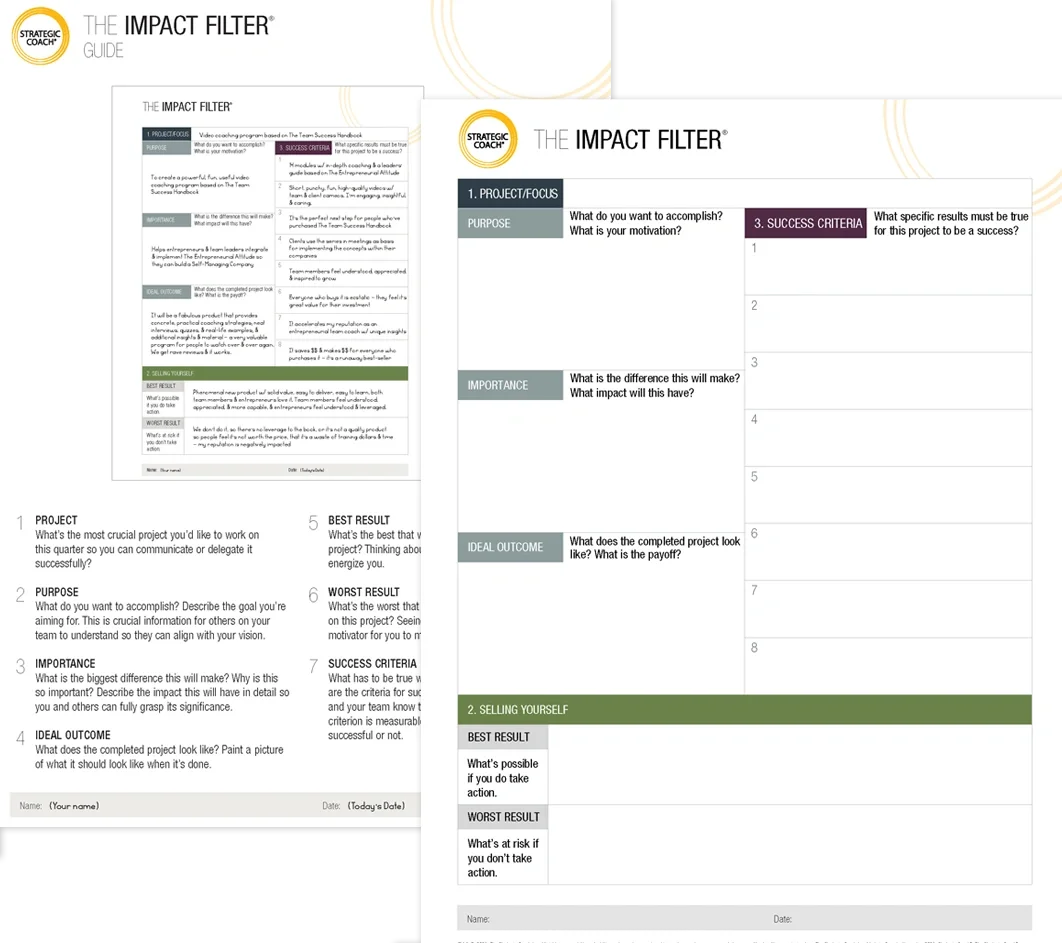
The Impact Filter®
Dan Sullivan’s #1 Thinking Tool
Are you tired of feeling overwhelmed by your goals? The Impact Filter is a powerful planning tool that can help you find clarity and focus. It’s a thinking process that filters out everything except the impact you want to have, and it’s the same tool that Dan Sullivan uses in every meeting.