How To Build AI Around Your Most Valuable Strengths
December 23, 2025
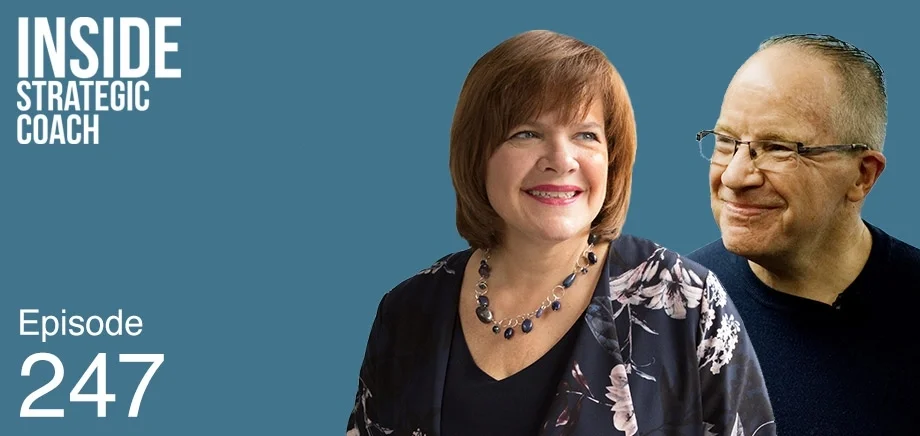
Hosted By
 Dan Sullivan
 Shannon Waller
Your deepest passion is yours alone, and what lights others up may leave you completely cold. In this episode, Dan Sullivan and Shannon Waller explore why every entrepreneur is born unique, how your experiences continually shape that uniqueness, and how doubling down on it leads to greater freedom, happiness, and business success.
Here’s some of what you’ll learn in this episode:
- How to strengthen and continually reinforce your passion.
- What actually grows and develops your uniqueness every day.
- What gets created when two people collaborate.
- How AI is multiplying individuality and adding even more variety to the world.
Show Notes:
Every person is born with a Unique Ability®, and that’s the central starting point for all Strategic Coach® thinking.
Your entire life is a process of navigating and giving meaning to the uniqueness of your own experience.
As an individual, you are constantly reinforcing a central set of interests and capabilities through every experience you choose.
When you go deep with anyone, you quickly discover they’re far more unique than you initially assumed.
Hundreds of times a day, you’re sorting experiences into “more of this, less of that,” steadily clarifying what matters most to you.
Entrepreneurs are the people who have bet the most on the thing they’re uniquely and intensely interested in.
To operate in the world, everyone has to learn a basic level of conformity—showing up, keeping promises, and finishing what they start.
Thanks to technology, individuals now have more freedom than ever to pursue and deepen their own interests.
Whatever someone is passionate about becomes the center of their universe, and they keep reinforcing it by seeking aligned experiences.
You’re always looking for experiences that make your passion and Unique Ability even more central and valuable in your life.
Powerful collaboration happens when people find shared interests where each can bring their own Unique Ability to create a “third thing” together.
Resources:
Who Not How by Dan Sullivan with Dr. Benjamin Hardy
Episode Transcript
Shannon Waller: Hi, Shannon Waller here, and welcome to Inside Strategic Coach with Dan Sullivan. Dan, you just said something I found really interesting, that you have discovered a new simplification, that everyone doubles down on something, and everyone doubles down on something different. So I'm curious as to know more about what that means.
Dan Sullivan: Well, in Strategic Coach, I think the central concept that we have going back, you know, we started our program 36 years ago. And I get the question every once in a while, you know, if you had one concept that you could take away and create an entirely different and new Strategic Coach Program, what would it be? And I say Unique Ability, that our central starting point in all of Strategic Coach is really that every individual is born with a Unique Ability. In other words, that their response to being an individual is that they're constantly reinforcing something in the center with their experiences, and that it's unique. Right from the beginning, it's unique. Their whole life is, to a certain extent, dealing with the uniqueness of their own experience. And I think that when you go really deep with anyone, you find out that they're more unique than you would have imagined, because we have to learn a certain amount of conformity in life just to get along with other people. And we have to learn how to show up on time, we have to learn how to do what we say we're going to do. We have to finish what we start in such a way to establish trust, establish cooperation and collaboration.
But when we're just operating individually as an individual, we're exploring all sorts of things and we're choosing, I like this, I don't like that. And that happens on a daily basis. It happens hundreds of times, I think, every day, that you're sorting out the experience that you like. And I think this means that there are certain things that you're intensely interested in as you go along, and a lot of other stuff that other people are intensely interested in doesn't interest you at all. I think we're living in a world where you're given more freedom to do this if you choose it. If you choose to just focus on what it is that really interests you. Of course, our entire experience is with entrepreneurs, and I think among all humans, entrepreneurs have bet on the thing that they're most interested in to actually make their living that way, to actually create their life that way. So, right off the top, that's some of my thinking.
Shannon Waller: I love it, Dan. There's a lot to unpack in here. One of the things that you said, like, all of us are sorting out our own experience, and I think we don't appreciate just how unique every single one of our own personal experience actually is. I'm actually talking to one of our clients, Dan Rogers, about this last night on another podcast is, you know, why am I so passionate about profiles and teamwork? Well, that was my way of coming to grips with my own experience. Came from a small town, moved to Toronto, which was a much bigger city. Was the country mouse kind of thing. And it's me coming to grips with my experience, which was different than other people's. But I used to think that everyone was more similar and I was different. Turns out that's not actually true. We're all unique and different in our own ways.
So I think that's a really key framework to remember. And then we have more freedom if we choose. So the degree of taking ownership of our experience and agency, that is crucial to this conversation. And then another thing is that we have more freedom now because of technology. Like if I'm interested in something, I can go to YouTube, I can go to Perplexity, I can go to any of the LLMs and just do that deep dive and geek out on it, which I love every second of. And it's just easier now than it ever was before. People used to have to walk miles to go to the library, you know, go back 50, 100 years. So that's kind of incredible just how much more accessible it is, but it doesn't mean that everyone will take advantage, is what I'm hearing.
Dan Sullivan: Well, the ones that you don't think are taking advantage are taking advantage of something else. So my sense is that everybody's interested in something. It's just that it might have importance to you, or you might think that that's worthwhile, or you might not think it's worthwhile as far as what you're interested in. But I got this idea that everybody's doubling down on something is equally distributed. I think it's equally distributed that what someone is passionate about, what someone's really interested in, is the center of their universe, and they're constantly reinforcing it. They're looking for experiences that make this more important to them, and that one of the things that we have to understand, that our thing is just our thing. The whole question is, can you find things that actually create teamwork with other people? In other words, you're both interested in it enough that you'll both make a unique contribution to something that you have in common. Because otherwise, it's just, you know, everybody's going off.
There's that thing where they would put mousetraps and ping-pong balls. It used to be a test, you know, you would have mousetraps and everything looked very even and everything looked very orderly. And then you just took a ping-pong ball and you threw it on all the mousetraps and it just was complete chaos. All the mousetraps went off, all the ping-pong, and then it wasn't so orderly. There's that, but my sense is that we combine two things that were unique in the sense that we can be constantly developing our own thing, we can constantly be reinforcing our own interest, but we can actually combine what we're interested in with what someone else is interested in, and we don't become alike with that, we create something that's a third thing. I was thinking about this before we came to the studio today that what we create in our podcast here is a kind of form of theater where you're a really great interviewer and I'm kind of a really great improviser. You ask me a question and then I can think thoughts that I've never thought before and I can express things that I've never expressed before, and then that triggers something in you to ask a question that's never been asked before, and it's a teamwork. Okay, but we're each kind of doubling down on the thing that we're really good at, but we're putting them together into something that's new and different.
Shannon Waller: And it strikes me, Dan, I can't do what I do without you. And you can get—any human being can get stuck alone with our own thoughts. If we don't have a sounding board, if we don't have someone to help amplify and multiply them, or to help simplify them, like we need that teamwork and collaboration to really get the fullness of the idea out there. And as you said, you think new thoughts and you express thoughts that you hadn't before, which is kind of magical. And it's fun for me, too, because that, as you said, provokes something in my mind. So I appreciate that thing. You know, is our thing something that we can build teamwork around is a great question.
Dan Sullivan: Yeah, because contextually we can create things in common with different kinds of content. We can actually combine the thing that we're most interested in. I've been thinking about this a lot because I'm approaching AI in kind of a way that's peculiar to me, I think, and that is I'm not exploring dozens of different tools, I have a relationship with Perplexity, which I really like. That was my first entry into the AI world, was Perplexity. When I first got involved with it, it just had a nice feel to it. And I said, okay, I'm just going to establish a working relationship with this one tool. And I hear about all the other tools and try this large language model and try this, and this does this, and this does this. I'm kind of like a one master dog. I've been working with it continuously now probably for about 18 months. Practically, it's really helped me. I think it's increased my writing speed by about four times. I think I'm getting things done much more quickly than I had before. And the writing that's coming out is getting more and more interesting to me.
But this is my way of going about anything. I mean, I go about relationships. I have very deep relationships. And the nature of the relationships is that they get better and better over time. I have a lot of really long-term relationships. So the way that I interact with really interesting human beings in my life is the same way that I'm developing my relationship with AI. And I go to a lot of events where people are talking about this new AI tool and that. And I just find I'm just going deeper and deeper with the one that I have and I'm doubling down basically. You could say I'm doubling down with it. But it got me thinking that AI is really interesting because I have a feeling that if there's 100 million people or whatever, half a billion people who are actively involving themselves with AI around the world, I don't know what the number is, but I'm sure it's at that level right now, I got a feeling that each of them is interacting with AI in a different way. It's not creating a mastermind or it's not creating a dictatorship of thought. Actually, it's creating an incredible more variety in the world. One of the things that I think the stock market is puzzled by, and I think the very, very large technology companies are a bit confused now. They're not seeing the technology going in a single way or going in a dominant way. The only thing that I see dominant that seems to be everybody's experiencing is that it's using up a lot of electricity.
Shannon Waller: Is it ever. Especially if you want it to be friendly.
Dan Sullivan: As a matter of fact, I think we're in a crisis. I'm keeping track of that this is a complete and total electricity hog. We've got to just develop way, way more electricity for this technology to keep advancing. But my sense is that it's very hard for people to get a handle on where is this technology actually going. And my feeling is that for as many human beings who are involved with it, it's going in that way. You know, it's going in billions of different ways, technology, and that it's really interesting to see how that impacts the marketplace, how it impacts, you know, the culture, how it impacts. But it seems to be not in the way that was being predicted.
Shannon Waller: I see that, Dan. When you had mentioned this to me about AI, it made me think of personal computers. You know, having grown up in the seventies, and it's like there was all big mainframe computers, only a few people had access to them, and it was limited, and you had to have certain credentials and what have you. And then when the personal computer came out, it was like, ooh, just totally empowered individuals to go and do things. And I joined Strategic Coach in ‘91, and I brought my own little baby Mac that's now a brick with a seven-inch screen with me. That was one of the requirements of the person who hired me. But I was equipped with that. Was relating to my husband that one of our first dates was me helping him to create this amazing business development proposal that he had for his role at the time. I created it on this thing, and that was one of our first dates, if you can believe it. So it's so empowering to the individual. And then AI is doing this.
Dan Sullivan: Exponentially.
Shannon Waller: Exponentially, like doubling, doubling, doubling down, which is kind of incredible. So, what I hear you describing is there's no convergence yet. Maybe there will be, maybe there won't. It's incredibly divergent because people are doubling down on the stuff they double down on, so it's serving their Unique Ability and what they're interested in.
Dan Sullivan: Yeah. I mean, my experience is that it's actually showing me some really interesting ways of how I think about things. One is that, you know, one of our books that's been a best-selling at Strategic Coach has been Who Not How. And I'm really discovering what the Who I'm dealing with can do. And once the AI can do it, then I don't try doing that anymore because I know the AI can do it. So I get to do different things with my thinking. But I'm really struck by this that there's a lot of articles, there's a lot of sociological articles or psychological articles that I come across about how people are spending more time alone now and they're putting it down to that this means loneliness and I'm saying I'm not entirely sure that's that's all true. I think that what the technology does is spend time on our own but with a capability that actually allows us to think about our thinking and to notice how we go about things, that it's a really interesting age that we're entering into.
Shannon Waller: Yeah, I would agree. Dan, there's something very, I don't know, empowering about, you know, it can help you write a better letter. I used it to write a testimonial today. There's lots of ways it can help you just do output. But when you can actually, you know, one of our clients, Chad Jenkins, did this. He took all of his, I think, Fathom recordings and put it in and said, hey, what patterns are you observing? It gave him an overview of what he's kind of been doing in the background and brought it to the surface that was incredibly exciting. Thank you, Chad, for sharing that with me. And it was like, whoa, like it can help you think about your thinking. It reflects your own experience back to you. It can reflect your words back to you and draw conclusions if you give it the prompt, of course, and ask for its input. But how incredible is that? So people might be spending time alone, but they're doing it with one of the very best conversational partners they've ever had. I think that those people writing those articles are not necessarily taking that into account.
Dan Sullivan: Well, the people who are writing the articles are doubling down on loneliness. In other words, they got their shtick. One thing that I have found very, very interesting, I read an enormous number of articles, the articles are mainly on the internet, and I read the articles, and where before I would kind of really buy into the point of view of the person writing the article. And now what I do is I just take the link to the article, and I'll go into Perplexity, and I say, this is an interesting point that the writer is making here. Give me 10 other dimensions about the topic that the writer is doing. And, you know, within seconds, I have 10 other things. And then I realized that the article writer is just doubling down on one particular point about a subject that's much wider than that. It's made me, I'm trying to find the word here. It's not so much cautious, but I'm just saying, well, that's one point of view, but there's a lot more point of views on the same topic.
Shannon Waller: I would say that's discerning.
Dan Sullivan: Yeah, I'm very discerning.
Shannon Waller: Yeah. I just talked with my daughter about critical thinking. She's finishing up her education. You know, one of the things I appreciate about universities is it teaches you to think critically. At least some do these days. That might be up for debate, but I appreciate that. People who can do critical thinking, who can, you know, think bigger. Oh, this interesting that this person's saying it, but it really is that the whole picture, which is exactly what you're talking about. So, if people are using it in the way you're talking about, yay. I just think that makes for a much more thoughtful discourse.
Dan Sullivan: But it's very definitely that we've entered into a new era of thinking. But I'm very interested that once a new technology is created on the planet, it goes in a direction that is oftentimes very, very different from what is predicted, what's going to happen. I remember reading about Alexander Graham Bell, who invented the first telephone. And his prediction was that its main use was going to be rich people listening in their homes to live concerts somewhere else. And that's what his notion is where telephone was going to go. And if you brought him back from the dead today and you showed him what a telephone looks like and what people are using it for, it probably would expand his notion of where his own invention was going.
Shannon Waller: Slash blow his mind. I love that. I don't know if it's a quote, Dan, or if you said, there's nothing more unpredictable than a consumer with a new technology, which I think is par for that course. It's spot on. So question, how can entrepreneurs apply this? How can they make this work for them? How can they use this thought process to really move things forward for themselves?
Dan Sullivan: I don't know. Quite frankly, I think it's too early. I mean, entrepreneurs, because entrepreneurs by their very nature are unique from each other, and they're unique from other people. But my sense is that the way I'm approaching it as an entrepreneur is that I'm seeing how well AI can help me be more prepared and more useful in my teamwork with people, you know, like where before I might have used people to sort out my thoughts, I'm using the AI to sort out my thoughts so that I'm really clear and simple when I get together with other people. So that's how I would use it, you know. I think the other thing is, after a while, I don't think we're there yet, is to get a sense of how another person is doubling down with AI and where they see that leading them.
Shannon Waller: I'm really struck, Dan, by your comment. We're entering a new era of thinking. And to my mind, one of the action steps from this conversation is put your thinking into your favorite AI, right? Whatever, if it's Grok, if it's Perplexity, if it's Chat, Claude, there's umpteen others, and just see what comes back. Like use it as a mirror. Use it as a source of reflection. Use it as a sounding board or a thinking partner. Because I think you might be surprised about what comes back, and it will undoubtedly, you're like, oh, I didn't see that pattern. It's pattern recognition. That's what an LLM is. And I think that would be another powerful way to take advantage. I mean, yes, use it for your writing prompts and stuff. Whatever you're passionate about to double down on, double down using AI, and who knows what will come back. I think that'll be a lot of fun. Great, Dan. As always, I like where our conversations go. To my mind, it's super cool that you spend a lot of time on AI almost every day, and hearing what you're doubling down on is always interesting. So, thank you.
Dan Sullivan: Thank you.
Related Content


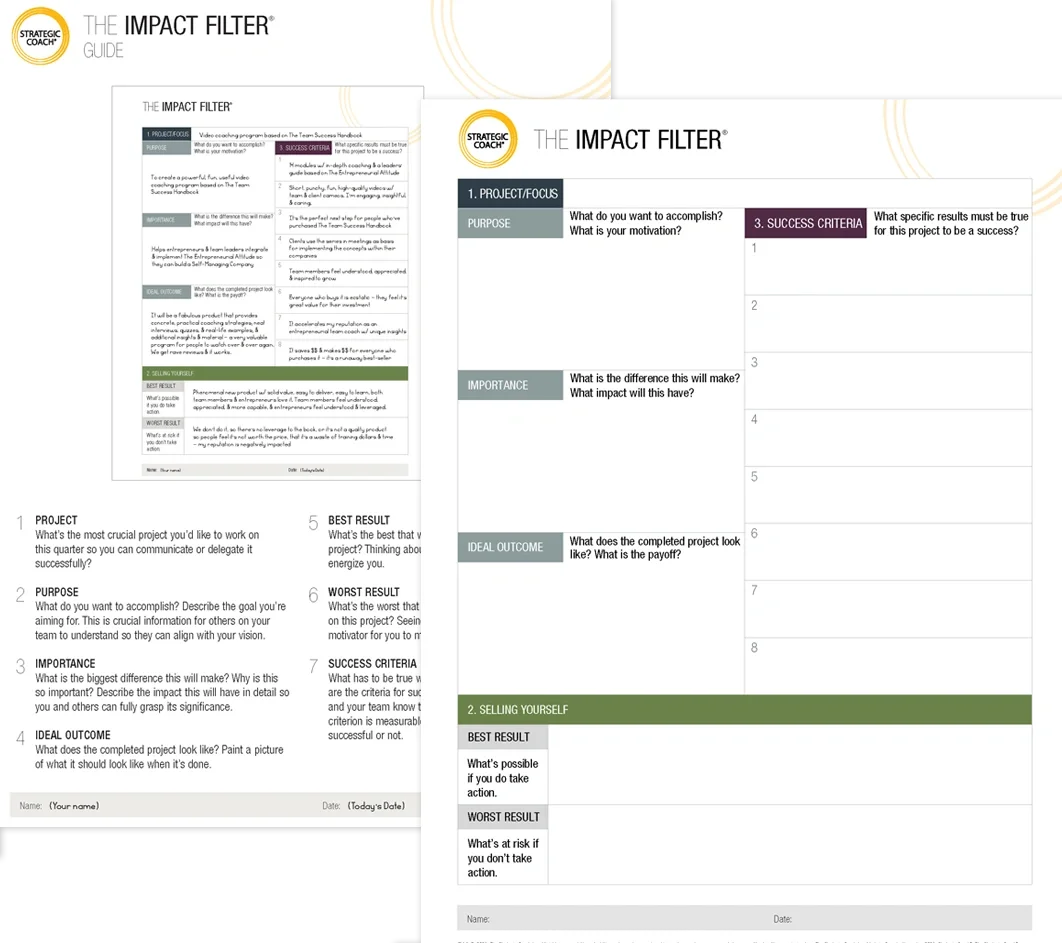
The Impact Filter®
Dan Sullivan’s #1 Thinking Tool
Are you tired of feeling overwhelmed by your goals? The Impact Filter is a powerful planning tool that can help you find clarity and focus. It’s a thinking process that filters out everything except the impact you want to have, and it’s the same tool that Dan Sullivan uses in every meeting.