How Entrepreneurs Are Using AI Without Losing Their Edge
January 13, 2026
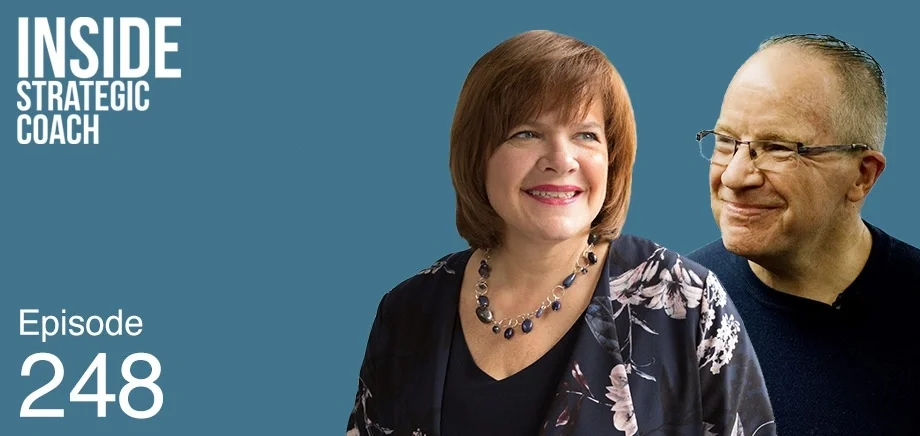
Hosted By
 Dan Sullivan
 Shannon Waller
Predictions have been made over the years, especially with the emergence of AI, that computers will be more intelligent than human beings. But humanity is always infinitely greater than anything that humans create. Business coaches Dan Sullivan and Shannon Waller discuss why computer intelligence can never compete with humanity’s intelligence.
Here’s some of what you’ll learn in this episode:
- Why a person’s intelligence doesn’t include only their own.
- What “humanity” really means.
- How successful entrepreneurs are using—and not using—AI.
- How AI is lessening the importance of experts.
Show Notes:
Humans communicate in many undetectable and immeasurable ways.
A single telephone has no value whatsoever.
With the addition of every new technology that allows human beings to interact with one another, the combined intelligence of the planet multiplies.
A new technological capability could never be greater than the total amount of thinking that all humans do.
You can’t be inside of a system and understand that system.
Computers are just a subset of human intelligence.
Unlike humans, machines can be consistent and constant in their use of intelligence.
Humanity is everything that humans have done over hundreds of thousands of years.
Resources:
“Overcoming Delegation Issues: A Comprehensive 5-Step Guide”
Episode Transcript
Shannon Waller: Hi, Shannon Waller and welcome to Inside Strategic Coach with Dan Sullivan. Dan, you just shared with me something you've been thinking about for a long time but have not shared yet about humanity. So can you introduce this thought because it's interesting and provocative as always.
Dan Sullivan: Yeah, well, it has a lot to do with the predictions that have been made over the years that computers, and especially now that AI is part of computing, that at a certain point, the computer will be more intelligent than human beings. It got me thinking about that subject and one day I heard a particular person talking about this. Something struck me and I wrote it down. This is a long time ago, 10, 15 years ago. And what I wrote down was that humanity is always infinitely greater than anything that humans create. So the whole point is that I think that we as humans communicate in an enormous number of ways that's not really detectable. You can't really measure. And that if you talk about the intelligence of a single human being, and, you know, people think that they have tests that actually indicate that, IQ tests or what, a cognitive test, it's like talking about the power of one telephone. Well, one telephone has no value whatsoever. It's only when you get another telephone that has value, and I think it's the way with humanity. If you have one human being, there's a certain amount of intelligence, but if you have two human beings, then the intelligence grows because you have an interaction. And every more human that you add to the picture, the intelligence multiplies.
So right now on the planet, we have whatever the number is that's closer to which billion, but it sounds like nine billion right now humans. And these humans are communicating with each other, you know, in person. Dozens, hundreds might be communicating in person, but now we have technologies. So my sense is that every time you add a new technology that allows human beings to interact with each other, there's a multiplying of the combined intelligence on the planet so that a new technological capability could never be great than the total amount of thinking that all the humans do. And there's actually a mathematical breakthrough that happened around the 1930s, 1940s, that Albert Einstein, who was a very intelligent human, said that this is the greatest mathematical breakthrough that's ever happened. And it was by a German Austrian, I'm not quite sure, I think he was in the border between Germany and Austria, by the name of Kurt Gödel, G-O-D-E-L, and it's got that umlaut, And he created a mathematical puzzle. It was like a mathematical riddle that proved in layman's terms, in everyday language, that you can't be inside of a system and understand the system that you're in. Another phrase is that if you're in a bottle, you can't see a label on the bottle.
There's a part of math which is called Set Theory, and you have set and subset. And in Set Theory, you would have humanity, or human intelligence, and then you would have computers, and that was human intelligence that created computers. It wasn't computers that created human intelligence. So computers are just a subset of human intelligence, and that's the way it'll always be. We've had previous podcasts where we talked about the interaction with AI and what that does for your thinking. And I was just thinking that all this prediction about what a machine can do and how it's going to expand to such a point where the machine is more capable, more intelligent than the human beings, it just struck me as silly. Because you're talking about a lone individual, one individual, and that the machine is smarter than the one individual.
Well, I already knew that from growing up because I always thought that the thermostat in our house was smarter than me regarding the furnace. The air conditioner is smarter than me about cooling, so you look at all the different technologies, and these one-purpose technologies, in regard to what they do, is actually smarter than the human being. That's why we created them, because they can be consistent and constant in their use of intelligence, where we're thinking about all sorts of things. I don't know what you think about this, but it was just a thought that I had.
Shannon Waller: I'm laughing about the technology being smarter than any one human. But it's interesting when you think about humanity. First of all, it's reassuring what you're saying, because I've read some of those same articles and those same predictions and listening to podcasts this morning about everyone replacing work and no entry-level jobs. And I think there is some, I'm going to say, temporary displacement for certain humans. I think there's definitely some reality to that. Am I worried about AI taking over my brain or my future? No, I am not. And I think because we've always at Strategic Coach done such a deep dive into Unique Ability and creativity. I know that there's no way, you know, I'm celebrating an anniversary this week of 30 years of coaching. I'm sorry, AI could not come up with the idea for the Strategic Coach Team Programs. Can't come up with the tools that I've created. Can't come up with open file syndrome and drive-by delegations. That's just not possible. That comes from real experience with real people, right? It can't come up with my leadership scorecard.
I have a lot of experience to validate what it can and cannot do. And I get to hang out with you and I get to hang out with other entrepreneurs who are making up brand new stuff. And these entrepreneurs are so savvy. They will use AI to support their thinking, to be better critical thinkers, as we've talked about in another conversation. But in no way is it replacing it. So that's my experience. And there's something about, you know, if you say humanity is always infinitely greater than anything that humans can create. So we are multipliers, and we multiply each other's, and especially when you talk about the connections between us, it involves a number that's way bigger than my brain can handle in terms of what's actually possible. So this lens is very true for me. I'm curious though, Dan, how do you define humanity? I'm curious how you define that.
Dan Sullivan: Well, it's that which is human, you know. I mean, it's the growth of knowledge, it's the growth of mindsets that humans have. I'm very, very struck because I'm very, very deeply interested in history, but I've been very interested in the development of entrepreneurism, essentially. There was another workshop in our headquarters in Toronto today, and I had lunch with about five or six of them, and they were just talking, and they asked me whether I cared about what was going on in society. Do you care about where things are going and everything else? And I said, society, that's an interesting idea. And I remember Margaret Thatcher, when she was prime minister, somebody brought up, well, what does society think about this? And she said, society? Does society have a street address that I can go visit and ask society what it thinks about something? And it really struck me that society is just an abstraction. It's just a concept that we have to have words that describe what everybody thinks together, but we don't actually deal with abstractions when we want to find out something. We talk to this person, we talk to that person, and everything, and we develop sort of a sense of, you know, what the people whose judgment you trust, you know, you appreciate, you respect, and everything. But it's actually what it does to your thinking that makes the difference.
One of the things that I think is happening is everything can be looked up now. That it has the impact of lessening the importance of experts. What I mean is that there are experts and this person knows everything about this. Well, as we find out, you could very, very quickly check that what that person knows about is only part of something much, much bigger and that there are people who disagree with him and disagree with her and that they have an interesting take on something but it doesn't necessarily cover the whole field in which they're operating in. So my sense is that what humanity as it's grown, it's everybody on the planet humanity, but it's not just that, it's humanity right from the beginning. And I said, the people who really know about anthropology, who know something about when humanity started and how long have we actually been humans? You know, how long does it go back? And it keeps expanding backwards. What I notice is that where maybe 25 years ago, people said, well, it's 100,000 years that humans have been around. It's now approaching a million. One of the indications that humans lived here was pottery, that they made pottery, and especially pottery that has an alcoholic residue. They're now finding that way, way, way, way back, humans were making pottery for the purpose of storing alcohol or making alcohol.
Shannon Waller: That's consistent.
Dan Sullivan: That shows a lot of intelligence, it shows a lot of intention, probably shows a lot of teamwork and everything else. And there's no indication that apes can do that. Anyway, but the interesting thing about it is that humanity is everything that humanity has done over hundreds of thousands of years. And it's what's taking place today, that's humanity, genetically how we've evolved and organizationally how we've evolved. And there's just a lot, a lot of thinking and there's just a lot of wisdom that goes into that. And what they estimate that the population today, which is the greatest that we've ever been, represents a very small amount of the total humans. They estimate maybe 110 billion people, but it's a guess. It's a guess. And you think about just the vast number of years where people have been having daily experience and checking out what works and what doesn't work. And that represents the total intelligence of human beings. And I just don't see how one creation of humanity, all the technology that's ever existed has been created by this human intelligence and everything else, how that can suddenly outpace all of the intelligence. So anyway, that's my thought. This is what I spend my time thinking about.
Shannon Waller: Well, I like the logic, Dan. And one of the things, we've talked about this before, but there's a lot of content out there, like a lot of content. And what I always appreciate from your thinking and when I hear it from others is context. That's a CliftonStrengths. It's one of the most rare, is context. And you have it in your top five. And it's just so useful to get the big picture because then people can just calm down. Because there's a lot of inflammatory news out there that does freak people out. And I think actually having this bigger perspective is really wise. So, this is a way of thinking. It's a mindset. It's perspective. So, in terms of how people can take action or how they can apply this to their daily life, a couple things come to mind for me. One is, don't be scared of what gets created. Take advantage of it. Use it for your own purposes. Trust that it will add to the, you know, knowledge and wisdom and mindsets of humanity versus the opposite. Any other takeaways that you can suggest in terms of how people can implement this way of thinking?
Dan Sullivan: Yeah, well, the conversation that I had at lunchtime and they said, well, don't you care about how society is going? And I said, well, I don't really have a grasp of what society is. And the other thing I said is that I find it's much more useful to think in terms of just individuals that you know. So I tend not to really, really care about humans as abstractions. I really care about individuals. You know, we have 120 in our company, and I care about those individuals. And we have 2,500 entrepreneurs in the Program right now, and I care about them. And I find that caring about those two groups of people is a full-time job, and I just don't have a lot of energy beyond the people I know, you know. The other thing is, this is probably a topic for another podcast, but caring is an interesting word. People say, I really care about this. And then I'll say, well, in the course of a year, how many hours would you spend actually doing something about what you actually care about? And it turns out they don't spend any time. The caring isn't actually measured in behavior. It's expressed as a thought that they care. And I said, so do you really care, which would mean that you're setting aside time in your schedule every week, every month, to actually do something about this caring? Or do you care to be seen as caring?
Shannon Waller: Signaling, yes.
Dan Sullivan: Yeah, in other words, are you signaling something about yourself, which in fact is not really backed up by your behavior? You're trying to get someone to believe something about yourself, but your behavior doesn't actually back that up.
Shannon Waller: I love what you're saying, Dan, because to my mind, people talking about something and feeling strongly about it and putting that emotion behind their words, but then when you ask about the reality, what are you actually doing to back that up? There's nothing. And one of the things I like about you and I like about Strategic Coach and I like about our clients is it's very practical and it's real. So, people will tell us what they've been doing, and that demonstrates what they care about. And there's a reality to that. And that's where you can make a difference. Like, you, I don't want to say take pride in being useful, but it's something that's important to you to be useful to others and to be in great teamwork with other people. And so, you have very practical things that you do to be a great teammate and to create value for your clients. You work hard to come up with new concepts, develop them, and you work with AI to deepen your thinking about it. Like you are very focused. And there are measurable actions that you spend hours a week doing for all of those things to do. It's not just something that's an abstract idea. It's very practical.
And I heard something, they were talking about Buckminster Fuller. Nothing abstract. He only wanted to basically reflect back what he learned through experience. So experiential was what he was focused on. So when he spoke, he didn't make anything up. It was in my experience, which I find so powerful. And that's one of the things I love about what you come up with and what I come up with in all of your publications and my fewer, is it's based on reality. It's based on real circumstances, what really happened. There's nothing abstract. Our research is real in-person experiences of what have happened. And there's such a tangible contribution that comes from that rather than some other abstract conversation that just has no bearing. So I love that.
Dan Sullivan: And this whole conversation just got out of something I wrote down. And you know, humanity is also an abstraction, but my sense is that we have no comprehension of just the extraordinary intelligence that has been created over hundreds of thousands of years by billions of human beings of just how to get something done this way rather than that way every day. And I can't see that there's going to be any creation that humans create that surpasses that tangible, practical daily intelligence.
Shannon Waller: Well said. Thank you, Dan.
Related Content

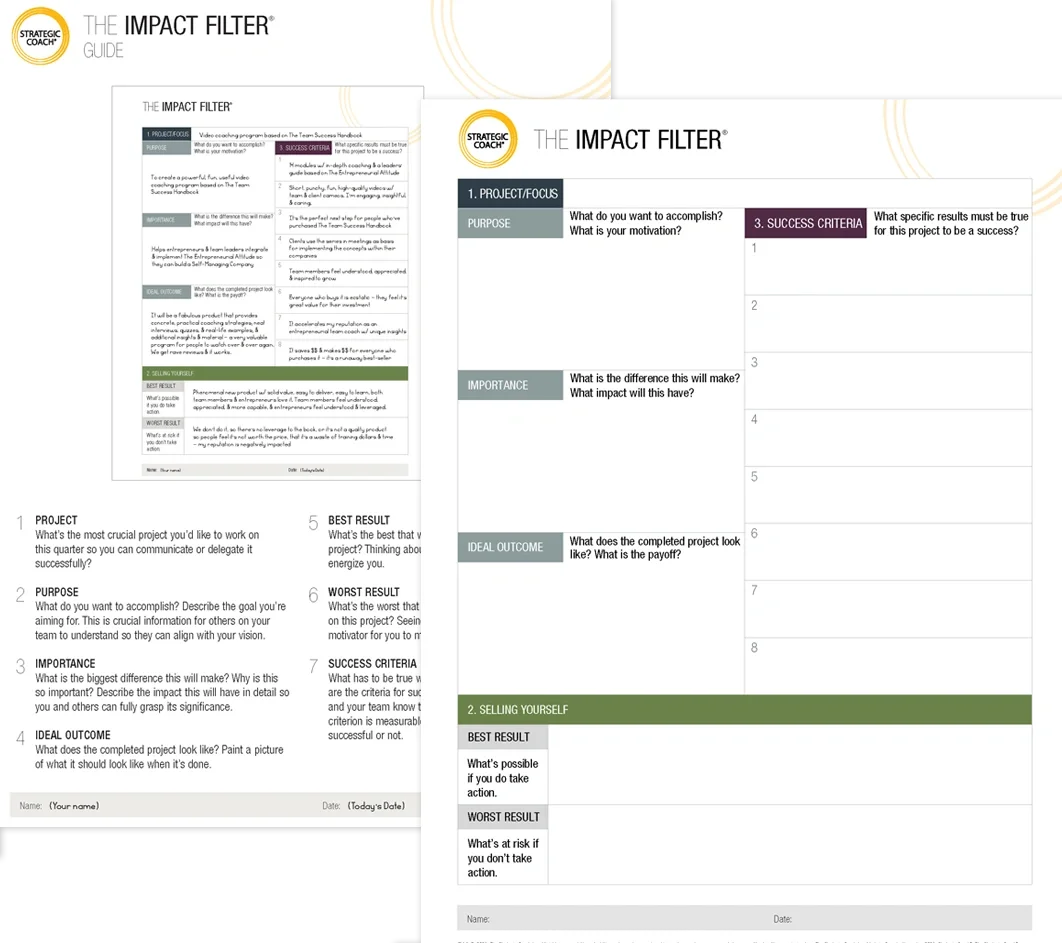
The Impact Filter®
Dan Sullivan’s #1 Thinking Tool
Are you tired of feeling overwhelmed by your goals? The Impact Filter is a powerful planning tool that can help you find clarity and focus. It’s a thinking process that filters out everything except the impact you want to have, and it’s the same tool that Dan Sullivan uses in every meeting.