This One Small Change Makes Every Day A Win
March 24, 2026

Hosted By
 Dan Sullivan
 Shannon Waller
What if your only job today were to create a great yesterday? In this episode, Dan Sullivan shares a simple daily mindset shift that keeps entrepreneurs grounded, focused, and remarkably productive. Learn how “creating yesterday” calms future anxiety, turns frustration into successes, and helps you fully appreciate the small actions that make each day a real win.
Here’s some of what you’ll learn in this episode:
- The real-life benefits Dan has experienced from using this daily focus.
- How to make sure you always remember your daily goal.
- An example of how to change a bad day into a great yesterday.
- How writing down small actions makes you more conscious, present, and productive.
Show Notes:
ADHD can pull your attention into endless future possibilities.
Thinking about tomorrow can make you feel great about what you’re doing today.
Focusing on creating great yesterdays keeps you grounded in the present.
Staying focused on creating a great yesterday helps you avoid feeling bothered by what you can’t control.
We never actually experience the future.
We can only act on the future when it shows up as the present.
Don’t let yourself get upset about something you can’t do anything about.
Stay in charge of your experience instead of letting situations be in charge.
Focusing on creating great yesterdays keeps you from getting worn out by the future.
Writing down what you do throughout the day anchors the experience.
Being conscious about the activities you’re doing has its own reward.
Resources:
The Gap And The Gain by Dan Sullivan and Dr. Benjamin Hardy
My Plan For Living To 156 by Dan Sullivan
Episode Transcript
Shannon Waller: Hi, Shannon Waller here, and welcome to Inside Strategic Coach with Dan Sullivan. Dan, you've been saying something that to me sounds like a Zen koan, and something you've also been practicing for a little while, and I am super curious to hear how it works and how you describe it, because it takes a second to wrap your head around it. So what you said was, today I create yesterday, yesterday creates tomorrow. Please explain, my friend.
Dan Sullivan: I have to give credit for the idea to Lior Weinstein, who's a great entrepreneur at Strategic Coach. And Lior was talking about a big sort of safari conference that he went to with a lot of parents and their children in Africa. Apparently there was a big bonfire on the final night and all the parents were going around talking about how they saw their job as creating a greater future for their children. And Lior said when it got to be his turn, I don't really know anything about the future. And I don't know what my children are going to do with the future. So I consider my job to make sure they have a great past. And it just stopped me, and I said, that's a really great perspective. This is a year and a half ago, so I've been playing around with the idea. And I'm two months into it of when I get up in the morning, I say, what I'm going to focus on today is that I created great yesterday, which occurs when I get up tomorrow morning, and I'll let an accumulating set of great yesterdays create tomorrow. And it really works. It's a really interesting perspective that grows. I've got 60 days behind me, so I've done 60 great yesterdays in a row. And there's a real sense of momentum. And the other thing is I'm clinically diagnosed with ADD. There are others who are also diagnosed, and some of them are undiagnosed, but they have ADD. With this great focus of using today to create yesterday, I've noticed that I'm not nearly as bothered by the future.
Shannon Waller: Yeah. That's really interesting, not nearly as bothered about the future.
Dan Sullivan: Or not at all.
Shannon Waller: And as we were talking before we hit record, one of the things that with ADHD, ADD, which I also am diagnosed, is that there are so many future possibilities and we get very distracted by them and we have trouble focusing on the present when we're doing that. So is that why your experience is that it's been very focusing and the future doesn't bother you?
Dan Sullivan: Yeah, I think that it's, I'm sort of living in a local time zone, you know, it's just I get up in the morning and I've got a whole number of activities that I already know about because they're scheduled. And then I'm going on 82 and, you know, I know my days, you know, I've got a way of going about each day. I'm not trying to do this, but I've noticed as I've had this focus now for two months, and December was by far my most productive month ever. And January was my most productive January. So I'm getting a lot done, but I'm just enjoying it. It's just that when I get up tomorrow, I just feel really great about what I'm doing today. So it's just a local, not peering at the future, you know, the future arrives as today, then I'll take care of that part of the future that arrives as today, because we don't actually experience the future. And we can only act on it in the present. So it's narrowed by focus, but I'm getting a lot done, as a matter of fact, more than ever. So if I understand it correctly, you wake up in the morning and you live that day with the intention—I've got a little reminder when I get up and it's just, I attach, I wear nightglasses, blue blockers at nighttime. And I just said, when you take the blue blockers off and there's a little case there and I put them in the case, when I do this in the morning, I'm going to remind myself that my goal for today is going to create a great yesterday.
Shannon Waller: Right.
Dan Sullivan: So you have to embed little reminders to do that. Then I feel good. So I only have from now until bedtime to have a great day.
Shannon Waller: So you make that a great day so that the next morning when you wake up, you can reflect and go, that was a great yesterday. Got you. So it's interesting as you talk about it, Dan, because it's like your hyper focus may not be the right word, but you're very focused on everything you're doing and that it's going to be great to the best of your abilities, circumstances, what have you, to make it great. And then go to sleep, feel good about it, wake up and go, that was great yesterday. And then do the same thing again.
Dan Sullivan: And I had a test of it, and I think it's very significant in my experience. Toronto has had a big blizzard. We were in Chicago, and our flight to Toronto was delayed about three hours. It was delayed an hour at a time, so it was going to be the next hour, and then when we got to the next hour, it was the next hour, then it was the next hour. And we got on the plane, and then it was very, very long on the runway before we took off. I think it was about a half hour on the runway before we took off. And then we got to Toronto, and they had no gate for us, and it was an hour and a half on the runway. It was kind of funny because I said, I bet when we get up to the gate, the jetway doesn't work. We got up to the gate, and sure enough, the jetway didn't work. And it was 45 minutes more on the plane before we got off. And I said, I bet when we get to baggage, we don't get our bags, which was true. We waited for a couple hours, and we didn't get our bags. So it was a delay of about six hours.
And I can remember myself in previous situations getting really angry about it. I said, remember, you're creating a great yesterday. You're creating a great yesterday. So I just read. I had my Kindle with me. And I read novels. So it was an interesting novel. And I was cool as can be. And Babs, my partner in life and in business, she said, you're really cool. But that's not so much doing something, it's actually not doing something. You know, it's actually not letting myself get upset about something that I can't do anything about. But I can do something about it. I can be cool about it. I thought that was a nice test. If that had happened three months ago, I think I wouldn't have been as relaxed about it. And I just said, it's a big system, you know.
Shannon Waller: Yep, monkey wrench got thrown in or several. Yeah, that's really powerful, Dan, because it means that because of your intentionality to have a great day, then great yesterday, I'm creating a great yesterday yesterday, because of that intentionality, well, to have a great yesterday, but you're creating that today. It puts you in charge rather than letting another situation be in charge. And that's a good test. It's a test that would normally irritate you, irk you, bother you, make you mad. And you're like, no, I'm going to make this my type of experience that I can reflect on and make it a great day. So I like it. It changes the locus of control back to you. And the other thing that really strikes me about this, it's keeping you in The Gain rather than The Gap.
Dan Sullivan: Yeah, that's another thing that I noticed is I'm not bouncing what I'm doing off some sort of ideal future result. It's just that I got home, I went to sleep. We didn't get a lot of sleep that night. You know, we were getting to bed that night about three o'clock in the morning and I got about six hours sleep and I got up and I had a great next day of grading yesterday. So anyway, I'm just testing it out and I've told people about it and they said, well, is this going to be a thinking tool Strategic Coach? And I said, I don't really know. I'm just being my own test animal here just to see. But I noticed with two months in, I'm noticing that it's grounding me very much. I'm feeling very much in the present at all times. It's just a neat way of not being tyrannized by the future.
Shannon Waller: Well, I just wrote this down. Very grounding, in the present, focused, and productive are really the by-products of this. And as you like to say, Dan, you like playing around with time. The Entrepreneurial Time System, ideal, I can think of a number of concepts. Living to 156. Living to 156, and this is the newest one. But this one strikes me as being particularly powerful.
Dan Sullivan: Well, I told people about it, and I was at a conference last week, and I told someone. It started on a Wednesday, but on Tuesday night, we had a dinner, this doctor. And I said, I'm just experimenting with this neat time concept. So not the next day, but it was a three-day conference. So on the second day, she said, you know, I tried that yesterday, and it really works. She said, when I got up yesterday morning, I said, this is all about creating a great yesterday. And she said, it was different. It was very different. And she was the day after she created a great yesterday. So she said, I was a lot more conscious yesterday. I came back to the thought four or five times during the day that I was creating a great yesterday. And she said, it makes a big difference.
Shannon Waller: Mm-hmm. Yeah. Well, this is great, Dan. Thank you. One last question. Do you write down what makes it a great …
Dan Sullivan: Yeah, that's the other thing. I actually write down little actions that I'm taking off during the day, and there's a weird little Dan trick that I do with write it down. So, for example, there's some pills that I take first thing when I'm out of bed in the morning. So I said, took morning pills. And it was accumulating during the day, little actions I was taking. I might have just taken the pills, but since I was writing down that I took the pills, it made me conscious that I took the pills. And by the end of the day, I had a number to 40 things written down. And I have this vivid memory of what I did that day. So I think it's important to record what you're doing during the day. You're sort of anchoring the experience. And then I said, something's missing. And I put the word no in front of each one of them, no taking pills in the morning. And I don't know why it works, but it works better than just saying took the pills. I'm just thinking it through right now. I'm just thinking through. But I think what the no is that I've had days where I went through morning to night and wasn't really conscious. And I said, if I put no, I'm just reminding myself that ordinarily I wouldn't necessarily be conscious of those acts, but now I'm conscious of the acts.
And what's building up is like we arrived home from a trip last night, you know, there's some unpacking to do. When we get home, I've got a CPAP and I have to set up my CPAP. But I said, now, set up your CPAP. And I was very conscious of setting up the CPAP. And I had a bunch of laundry to go into the washer last night, and I went downstairs. But I was very conscious I did it. And, you know, we were in the air for five, six hours yesterday. Usually I'm a bit jangled, and because I had these specific activities and I was going to record them, I said, if I'm going to record them, I might as well be fully conscious of them. So I'm in the early days. So it's just an interesting time frame. And I'm hearing all sorts of things on the news. I'm a news junkie, and somehow it's not having an impact on me the way it has before. We're going to write a quarterly book on this during 2026.
Shannon Waller: So anyway, it's a very simple thing, you know, it's simple, but also, I think, very profound, because as you say, you're more conscious, you're more present. You're not distracted by the million possible futures out there and nor are you measuring yourself against it. So you're in The Gain. But also the way you talked about even those small tasks, there are two things about that. One is you're not procrastinating because you want to write down because then it makes it a great day. So another end to procrastination, which is kind of wild. And I think the other thing, especially for those of us been around for a while and figured out a few things, we don't appreciate necessarily all of the steps of the things that we are doing already. So bringing that awareness back to those things, all the habits that you stacked, all the things that you do that really work, we take them for granted ourselves, so we don't get the benefit. And this simple but profound practice brings all of that back to bear, which is kind of cool. And the fact that it leads to greater productivity and focus.
Dan Sullivan: Yeah. And no ADD. I mean, it's really great. And when I began to realize it's not even the activity itself, whether it's an important activity or not an important activity, is that consciousness that you're doing, it has its own reward.
Shannon Waller: I like that.
Dan Sullivan: Yeah.
Shannon Waller: All right, well, Dan, thank you so much for sharing that. I think that will be enlightening for a lot of people. And if you try it, please let us know, questions@strategiccoach.com. We would love to hear your feedback. And as we talked about, it will be a quarterly book, so we can start gathering all of that experience now. Dan, as always, thank you for leading the way.
Dan Sullivan: My pleasure.
Related Content



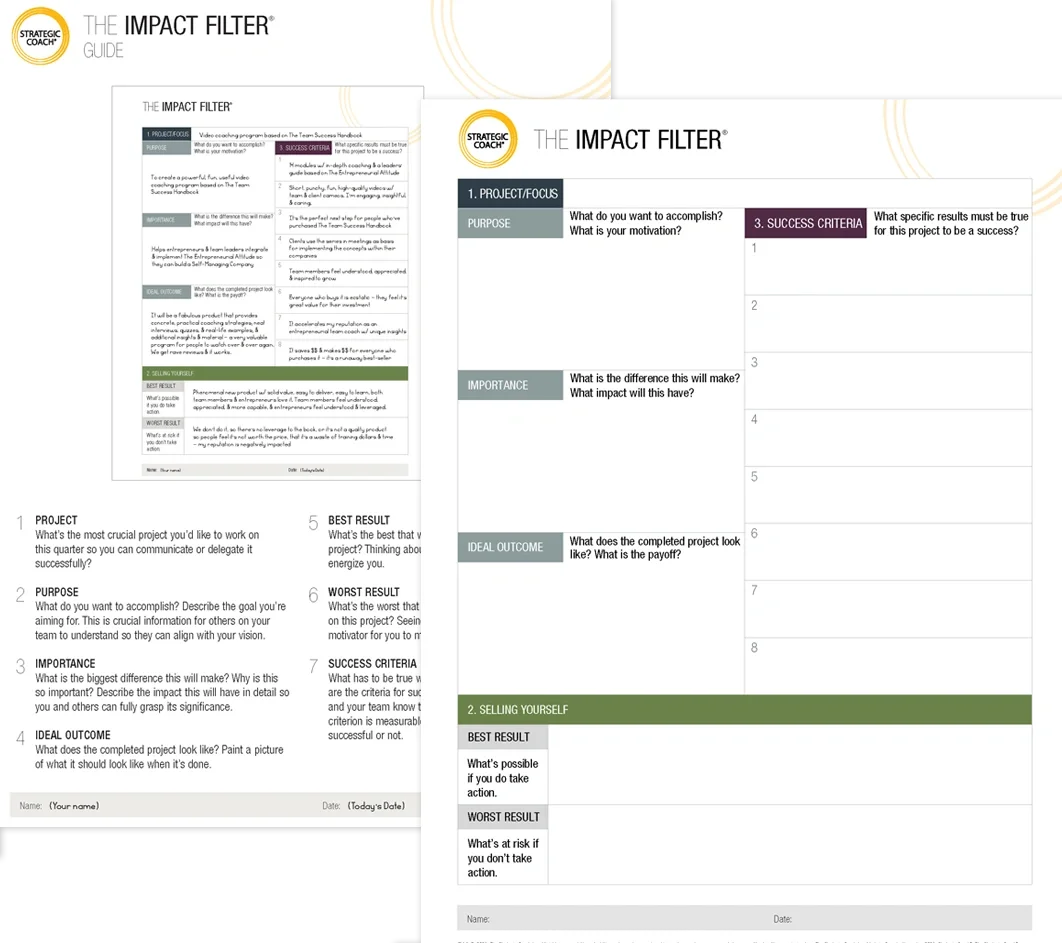
The Impact Filter®
Dan Sullivan’s #1 Thinking Tool
Are you tired of feeling overwhelmed by your goals? The Impact Filter is a powerful planning tool that can help you find clarity and focus. It’s a thinking process that filters out everything except the impact you want to have, and it’s the same tool that Dan Sullivan uses in every meeting.