A Permanence Of Disbelief
January 12, 2026

Hosted By
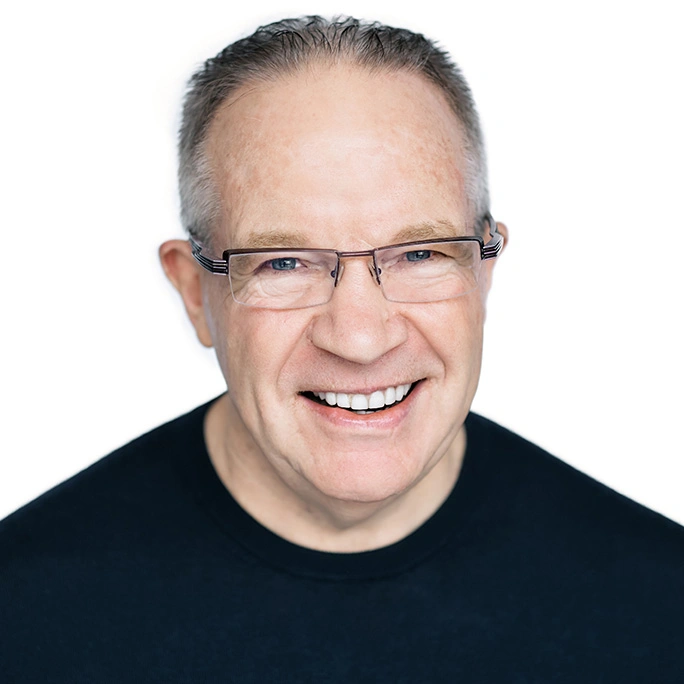 Dan Sullivan
 Gord Vickman
In a world of misinformation and deep fakes, an entrepreneur who is selling based on trust is a beacon of light. Dan Sullivan and Gord Vickman let entrepreneurs in on a timeless system for becoming a source of truth.
Show Notes:
In every interaction, part of the human brain is quietly assessing whether someone can be trusted.
At its core, marketing is about presenting something that feels credible and valuable enough for people to quickly say yes.
The more self-awareness you have, the easier it becomes to understand others and relate to them.
Trust matters because it creates predictability. When we trust, we can better anticipate outcomes and decisions.
Our sense of knowledge is built from countless small facts that gradually come together into a larger understanding.
With the rise of deepfakes, we can no longer rely on our senses the way we once did—seeing is no longer believing.
A simple rule that always holds: create value before you ask for anything in return.
Education doesn’t stop at school. Life continuously adds new layers to who you are as a unique individual.
The most important story you tell is the one about yourself. It’s through how you act, react, and show up in different situations.
Resources:
Primal Intelligence by Angus Fletcher
Episode Transcript
Gord Vickman: Welcome to the next episode of Podcast Payoffs. My name's Gord Vickman, here with Dan Sullivan. And today, chatting a permanence of disbelief. We're going to go far, we're going to go wide. And the goal of our show today, Dan, is to give ambitious entrepreneurs a dead simple, timeless system for becoming the one source of truth in a world of B.S. and deep fakes. And there's plenty of examples that we're going to explore if you stick with us today. And at the end of it, what you're going to leave with if you're an entrepreneur and you're selling something that's based on trust—let's face it, who isn't?—here's your opportunity to be that beacon in a world where everything else seems to be a little bit fishy these days. Did I do that justice, Dan?
Dan Sullivan: Yeah, I was just answering the question for myself as you were explaining it. As part of communication, probably going back to early human days, you know, when groups were very small, you knew your family members and maybe tribe members, and you could trust them, but someone who wasn't a member of your family, wasn't from your tribe, you had to learn how to distinguish good from bad pretty quickly. So my sense is that part of the brain is establishing any place, any time, anywhere, anyone, trust or no trust.
Gord Vickman: Coach is based on trust. Would you say that's not mitochondria in the cell here? I mean, I would suggest the nucleus of what is done at Strategic Coach is based on the trust that members of Strategic Coach place not only onto you, but our coaches, to deliver on that which we've promised.
Dan Sullivan: I watch it because I'm in associations and networks of marketers. Marketing is you present something that's trustworthy enough that somebody will buy it, you know, and buy it quickly. I've been playing with this idea recently that there's a thing you have to do with yourself before you can do it with anyone else. It's just an observation that's self-knowledge, if you have self-knowledge. In other words, you really, really do know who you are. It's easier to understand other people. You understand the kind of thinking that you have to do in relationship to your own experience, you know, and you got to articulate it to yourself. You got to articulate your experience. Like, for example, I grew up on a farm. You know, my daily existence from two years old to 11 years old was being on the farm. And you get to know farm life, you get to know farm neighborhood, you get to know the farming year, the seasons and everything. And there's an enormous accumulation of little facts that come together to give you a sense of knowledge. When you meet someone else who said they grew up on a farm, I've only had one experience where somebody kind of wanted me to believe that they had a farm experience, but the truth was they lived in the city and they had 10 acres outside the city, and they would go out on weekends. And you could tell within a minute, you didn't really grow up on a farm. And what we're looking for is predictability. I mean, I think that trust is essential for predictability because you have to guess and you have to bet that this is what it seems to be and that gives you the reason to move forward. I think it's getting tougher with the new technology.
Gord Vickman: Certainly is. I think everyone's favorite, well, I shouldn't say everyone, but my favorite story for the uninitiated, I'll give you the Reader's Digest version here, Arup. This is early 2024. This made headlines. We're going to refresh if you're not familiar. So Arup is a big UK design firm. It's heavy industry. They do railroads, buildings, just heavy, heavy industry. They're global. They had a guy in Hong Kong who got a phone call from someone who he believed was on senior leadership team based in Europe, okay, in the UK. He said, hop on a Zoom call with me, would you? And he said, no problem. Seated in the Zoom room or Zoom rooms were members of the leadership team and their instruction was quite clear. We want you to wire 25 million pounds to these various bank accounts for whatever reason. It was convincing enough. So this guy was a bit skeptical because it was a strange and unusual request to have this much money being moved. But the senior director was on video telling him to do it. Many of his associates were also on video telling him to do it. The voices were perfect. They were there. They were on Zoom or whatever video communication tool they were using. They were there. So what happened? None of it was real. It was an elaborate…
Dan Sullivan: The $25 million was real.
Gord Vickman: $25 million was real. It was an elaborate deepfake. So they said the scammers used super advanced deepfake technology. This is Hollywood stuff. So these were not petty criminals. These were smart, smart, talented, media savvy, artistic, I would argue. They were artists, but also scammers. And they convinced this poor guy to wire 25 million pounds to these various bank accounts. And even as sure as we sit here today, Dan, in late 2025, going into 2026, the perpetrators have never been caught. The money has not been recovered. The guy thought he was doing what his bosses told him to do and seeing was not believing because the guy on the screen, which was clearly his boss, was not. It was simply a deep fake. It was someone else making it all up. So we're talking about trust and it used to be you could potentially rely on at least a few of your own senses like your eyeballs and your ears for the basics, but you can't even do that anymore.
So the thought that I had that led me to title the podcast “The Permanence Of Disbelief” is like, you know, in years past, it's like, oh, pretty soon with AI, you're not going to be able to tell what's real and what's not. Well, guess what? It's already here because we've seen people duped as recently as 2024. And now it's even getting better. Recently, Google released Nano Banana Pro. This is their latest image generator, photo manipulator, and I've played with it myself and I've seen examples and we are officially at the point where I believe photos, if it hasn't happened soon, but it will happen where I don't believe photo evidence will be admissible in a court of law anymore because the photos and the image generation that this Nano Banana Pro—and again, I don't have an affiliate link for anybody, I don't own this thing, this is Google, but the photos it's generating now are indistinguishable from anything that a professional photographer would take. The day is here. Your eyeballs and your ears can no longer tell you.
Dan Sullivan: It's really interesting, it would be that story, if it perpetuates itself, like this starts happening a lot, it actually undermines capitalism, because the best definition of capitalism that I've come across, he was an Austrian economist by the name of Hayek, F.A. Hayek, very famous, 1940s, 1950s, 1960s. And he said, you know, the big problem with capitalism is that it's not about capital. He said capital is a by-product, but capitalism is an ever-expanding system of increased cooperation among strangers. Okay. The essence of what holds capitalism together is trust. If you can't trust, you can't do the deal. So how would you protect yourself from this, Gord? Somebody did a plausible deepfake presentation to you, looked like me, looked like Babs. If you were to not immediately agree, what would be going on in your head about that? What kind of thinking would you be doing to say, you know, I think I'm going to demand personal proof. I want to actually talk to Dan personally or I want to talk to Babs personally on this.
Gord Vickman: Me personally, how I would handle it? Here's what I would do. So it's me and you and Babs on a video call and you're telling me to do something which is somewhat strange, especially financial, very much out of character and totally out of left field. I would say all of this sounds good. I just need a few moments. And then the call would end. And then what I would do is telephone either you or Babs on your number and say, okay, you guys are going to think I'm totally cuckoo bonkers here, but I just, that video that we were just on, again, I'm not hallucinating, not on crystal methamphetamine. I just want to make sure that what we were talking about is real.
I got a bank transfer from our money folks at Strategic Coach. There was a discrepancy. I got charged. I was somewhere doing something. I was at a conference, whatever. They charged my personal credit card something that should have been on Karen's card, but it went to me. And I was like, okay, no problem. So someone on our accounting team here said, okay, we're going to send you an e-transfer. We're going to send you like this 70 bucks on e-transfer. I said, okay. So it landed in my inbox. I went on to our RingCentral and I actually phoned the individual in our accounting team and I said, did you just send me an e-transfer this day, this time? Is this real? They said, yeah, that's real. Okay, go deposit it in your bank. Even though I knew it was coming, call me paranoid. But I think we're at the point right now with the permanence of disbelief that even though someone says through an email, we're going to send you an e-transfer and then it comes, taking 30 seconds to go and verify that. Even if I saw you and Babs and maybe Shannon's there, Tami's there, Glenn's there, all these individuals in our senior leadership team, even if they're all there and everyone's agreeing, I would at this stage, late 2025, early 2026, I would still pick up the telephone. I would still call. And I think that's what people are going to have to start doing.
Dan Sullivan: We have this really interesting speaker who's going to be the first day keynote speaker at CoachCon in Orlando, first week of June. His name is Angus Fletcher, and he's got a big book out right now called Primal Intelligence. I wrote him an email, and I've had a Zoom call with him, and I said, you know, I think this is probably the single most important book that I've read in the last 25 years, your book. I sent him a note. I know how to get someone to return a call. I said, dear Angus, I just bought 200 of your books. I wonder I can get a half hour Zoom call with you to tell you how much I appreciate it. He was back like a rocket, he had been back. So create value before you ask for something. So I created value. And I've been talking to Strategic Coach clients. I gave the book and they said, this changes everything, what he's talking about. And he said, there's a new kind of thinking that we're required, which is actually an old kind of thinking. And the new kind of thinking is that more and more we're presented with chaos, and we don't get a lot of information, but we have to make a good decision. So in a chaotic situation, where you don't have much information, how do you make a good decision? In other words, things work out for you.
His thesis says you have to have a story about yourself, that you are continually building a story for yourself. So your education in life is actually continually adding new dimensions to who you are uniquely as a person. And then when you're confronted with a situation that's brand new, different, and everything else, you bounce the story off what's being presented to you. And he said, probably you're gonna make a good decision there. And so I think you've done this before, Gord. I think that this has happened to you before, and it's part of your story. So you immediately came up with the right way to check this out to see if it was right or not. And the fact that it seemed to be Dan, it seemed to be Babs, and they were telling you to do something that was out of left field, it was very, very different. You bounced your story off this and said, gotta check this out first. And his whole point is that this ability, this storytelling, he says it's storytelling, but the number one storytelling activity that you're doing in your life is you're telling a story about who you are and how you respond in many different situations. And you know, you, me, anybody, we've responded to untold millions of situations, and if we're in touch with how we went about doing that, then we know what to do in a new situation going forward.
Gord Vickman: What I would do in my mind in that situation, like you weigh the pros and cons. Okay, so not double checking by just calling Babs on her phone. So what's the worst that could happen to you in this situation? A, Dan and Babs think I need a nap desperately because I've lost it for a few hours. That's not great, but you've probably thought that a few times over the years of working together. Gordon needs a nap. Or I wire 500 grand of Coach's money to a filthy Russian bot farm. I would rather you guys think I'm a weirdo for like an hour and then you forget about it and then the next time we see each other, it's not even the topic of conversation than wiring a scammer in Bangladesh $500,000 of Coach money. So that's the trade off, right? Let somebody think you're weird as opposed to getting involved in financial transactions that for the most part are irreversible because once the money is gone, it's gone.
Dan Sullivan: Yeah. Whenever people with bad intentions approach the world, they try to come up with new tricks. If there's a new tool, they want to come up with a new trick. I was at a conference once and there was a man who was cyber security policeman. He was on the police force, but he was a cybercrime policeman. And he had been a beat cop in Los Angeles. You know, he had been on the streets, but he was noticing more and more, and this is within the last 15 years, that it wasn't breaking and entering, it wasn't assault and battery, it wasn't shooting, it was digital crime. Money was being stolen digitally. And he began to look into it, and he said, for example, he says, I'm going to tell you that there's a skyscraper in downtown Moscow. It's 25, 30 stories. Each floor is filled with people, and he says, you know, the top floor is the United States tool. What they're doing is they're doing online theft all day. He said they show up just like office workers do everywhere. They come in at nine, they work to five, and other people come in at five. You know, they work three shifts, and all they're doing is stealing online. And he said the Russian economy depends upon this building, you know, the assets that they steal every day. So, he says it tells you something about the future of the Soviet Union, that this skyscraper is probably the most important building in Russia, because they're just stealing. But I'm sure that in China, it's not a skyscraper, I'm sure it's a whole section of a city that they're just stealing. But if the most important economic activity of your company is stealing, you don't have much of a future.
Gord Vickman: We're not trying to pick on any one geographic location, but let's be realistic. Most of them are coming from the same four places and we all know who, where those are. That's a bad one. I wonder if anyone ever answered that guy's emails, because he's got a lot of money that he wants to give away. It'd be fun just to answer him once and be like, okay, send me a million bucks. See what happens. So now, these are the most nefarious, dirty, filthy examples of people scamming money and everything. But I mean, we can make it more lighthearted here.
Dan Sullivan: Well, it could be political. It could be something that shows depending on how you vote, the other side, and you're doing something that looks totally real, looks like it was being videoed, and he said this, and everything like this. It never happened, but millions saw it.
Gord Vickman: But even on a nicer plane here, we can, like we said, it doesn't have to be so evil all the time. It can be aspirational. It can be entrepreneurial.
Dan Sullivan: What do you mean by that, Gord?
Gord Vickman: Let's go back a few years now. We're talking 2021. I don't want to pick on LEM List, but I will. So there was a cold outreach platform that you could use on LinkedIn. And what it was, you'd record one generic sort of foundation video. It's just guys doing cold outreach, okay, for their whatever they're selling, their SaaS, usually a digital product of some kind, or they want to meet with you, right? They're just they're trying to warm people up. So you'd record one video and then you'd hold up a coffee cup. It was usually white. You could hold up anything, though, and it was your standard pitch. And then these AI capabilities would go and change the name for each of your prospects. And that white coffee cup that you were holding up, it would actually scribble the name of the person on it. So if I'm trying to reach Claire, okay? So I would be like, hey, I'm Bob Terwilliger, and Claire, do I got a deal for you! This is going to change your life, blah, blah, blah. Why don't you meet me for a digital coffee? Just go on my Calendly, and then I, quote on finger quotes here, hold up, and I have Claire written on the mug.
Really clever, really fun, for about two seconds. Because eventually, everybody, within like a week, everybody knew that all these videos that people were reaching out with, cold outreach, were being generated from a spreadsheet. The guy was not talking to you. He didn't write your name on a coffee cup. He just uploaded the spreadsheet of his coldest prospects. And now you get a more finger quotes here, personalized video. So it backfired spectacularly because in the entrepreneur's effort with the best intentions, this person wants to save time. They want to save effort. There's this platform that says we can generate one thousand personalized videos for all of your coldest prospects. They look like they were tailored directly to that person. It's going to make that person feel really warm and fuzzy. And then they're going to call you and write you a check.
All it did, I believe, was probably alienate everyone on your list because who do we do business with? Dan, you've said this a million times. People will be like, no one trusts. The first thing you do is you're trying to trick me. If that's the first thing you do upon first contact, the first time we have our first touch, you're lying to me. You're pretending that you made a video for me, but it was just AI that made it. What is the rest of our potential relationship gonna look like if the first time we have a touch, you try and deceive me. So many prospect lists were probably torched into oblivion, tossed into active volcanoes with those AI platforms that were designed in good faith to try and help people get a little bit further along through the funnel. But it backfired spectacularly because everybody knew it was BS right from the start. And now nobody uses them again. So absolutely Olympic sized flame out.
Dan Sullivan: Yeah. I'm going to bounce something off of you right now. And my sense is that as we exist today, you and me, we're incredibly smarter than people in, say, a comparable position were a hundred years ago; that we've got millions and millions and millions of little pieces of knowledge that we put together that we can tell whether it's real or not real, whether it should be trusted or not trusted. And my sense is that the human race right now is learning massively in response to AI. Okay? And the amount of learning going on today is as great as the amount of learning when lions were the problem, you know, or Genghis Khan was the problem, you know. We're learning, we're sending word ahead, we're getting advanced warnings and everything. I mean, we're just having this podcast, but the podcast will go out to thousands of people. And they'll say, you know, I saw this podcast today, and they said, don't believe if something looks real. And all of a sudden there's a consciousness raising that happens about it. Here's another idea that I'm thinking, all math scores and verbal literacy scores in schools in Canada and the United States are down. They're dumb. They don't know math. When did you have a basic hold on elementary math? Adding, subtracting, multiplying, dividing. What age were you when you had a good grasp of it now, as you have right now, and you're good at it now?
Gord Vickman: I mean, when do you get that foundation? I'd just be guessing, probably grade six or seven. Grade two, I think, is when you can confidently dive into addition, subtraction, division, multiplication.
Dan Sullivan: Well, in my days, I'm older than you, but we had it paced by the end of the first year, had the alphabet verse, we had sentence structure, we had everything down, you know. My sense is that that was important for your success in the old days. I think knowing how to operate in a digital universe is the skill that's needed this day. So a lot of the attention and a lot of the learning that young people are doing are actually operating in this world. How do I get used to this? How do you avoid getting tricked? Who do you check with to check if something's really real? So I did a Perplexity search and I said, has it always been the case that 50-year-olds were really scared that the 20-year-olds weren't ready for life? And it goes right back, as far as there's written history, every older generation, maybe two or three generations, you know, you're 50, 60, you're in your third generation, and you're always despairing of, they're hopeless.
Gord Vickman: Yeah, that's true. Aristotle wrote texts about wayward kids these days. They're never going to amount to anything because they're not focused. This is Aristotle writing volumes about kids these days, shaking his fist. So it's been going on for a long time.
Dan Sullivan: I just think that there's a generational bias.
Gord Vickman: Oh, sure there is.
Dan Sullivan: There's an enormous generational bias. A simple one, nothing disastrous, is taste in music. Like, I'm ‘40s and ‘50s. It's the old American songbook. It's Natt King Cole. It's Tony Bennett. It's Julie London. It's Ella Fitzgerald and everything else. And they say, yeah, but what about stuff from the ‘70s? And I said, noise. It's all noise. Last 50 years, it's just noise. You're someplace, you don't have control of the music, and you're listening to it, but it's just noise.
Gord Vickman: See, I was a ‘90s kid, and I grew up on punk rock and heavy metal. So it was definitely noise, but it was noise that was appealing to me at that time. It stirred in nicely with my teen angst.
Dan Sullivan: Yeah, yeah. But what I'm saying is, I'm just applying generational bias to one subject there, music. But I think it's a 360 degrees that, what was normal when you were growing up? What was part of the environment when you were growing up? I just wrote an article and it was about Trump in Canada. I wrote Perplexity. And I said, I've been in Canada now for going on 55 years. And I was saying, what's the cultural center of Canada? Americans, it's one of the real Americans think is it's real rugged independence. There's a real streak of independence. You know, don't tell me what to do and everything else. And I said, I'm convinced that the most fundamental, deep cultural trait of Canadians is niceness. They're nice. Canadians are really nice. So I did 10 contrasts of a nice culture responding to someone like Donald Trump.
Gord Vickman: And what happened?
Dan Sullivan: Oh, I mean, these nice people really get angry. These nice people really get angry, because he's not nice. He's just not a nice person. Apparently, when you're in private with him, he's very gracious, he's got tremendous attention, he listens, he asks really good questions, he gets a feel for what you want and everything like that, but he doesn't show up in public, because he's directing all of his public comments to the people who hate him. Every day he gets up, how do I blow the minds of the people who hate me? And my supporters love me for doing that.
Gord Vickman: Forty chess people have said he's speaking to the establishment the way that everyday Americans wish they could. And that's one of the reasons why he's beloved by his supporters.
Dan Sullivan: Oh, yeah. But the interesting thing about this is since I'm not on social media at all, I miss most of the … but that's a generational bias on my part that I'm not on social media. I mean, you have a certain quota for media in your life, and I have radio, and radio's good, and television is good, but I don't watch television, I watch YouTube. Being on your computer's a good thing, but I have a cut-off point where I don't need any more messaging. So, the article that I wrote, which I sent to you today, about, I've never been on social media, I don't know how to get on social media, I wouldn't know how to receive someone's social media message, and as far as I'm concerned, I haven't missed anything. But what I notice is that the things increasingly that Strategic Coach clients are complaining about or team members are complaining about is because they're on social media. They've seen something on social media that really disturbs them. And I said, yeah, I didn't see that. I'm not disturbed. So my sense is that we're into a new thing, you know, and my sense is that the brain size of humans has grown and we've adjusted to all sorts of things and we have the experience of adjusting to new things and we'll adjust to this.
Gord Vickman: You know, it's almost like two silos here. There's the tech stuff is what's believable and what's not online, what's trustworthy and what's not. We'll leave that to the side for now, because we covered that a little bit. But I think with tech, you're going to have to fight fire with fire in terms of, you know, you're going to fight pixels with pixels and binary with binary. Let's wrap the show with talking about the human experience, because at the end of the day, that's all we really have. If the whole power grid goes out as soon as your laptop dies, this is all we have. And the Wi-Fi is not working. So, can you think and perhaps provide one parting gift to the entrepreneurs who are enjoying the Podcast Payoffs today? What is one tell? What is one specific thing that will be timeless advice in terms of knowing what deal or what relationship, which partnership, to move forward with when you meet someone brand new? Is there a specific rule or something that has gone through your life like a vein of truth that you could share today that maybe is indelible or could be just maybe something that you learned recently, but what is that one thing that makes you go, I think this is going to work?
Dan Sullivan: I use as a thing that works for coaching, it works for communication, you know, it works for marketing, is that I get people in touch with their own experience and ask them questions about their experience. And then I hear their answers to them getting in touch with their experience. People who really are straightforward will really tell you stuff that's very, very important about their experience and people who you should not be trusting won't give away anything. They'll give you like a commoditized answer. People who are really above board and they're really straightforward and they are goodwilled will give you highly specific answers to specific questions and people who aren't will give you a programmed answer. And you gotta learn the difference between a specific, unique, experiential answer and a commoditized answer, an algorithmic answer. They're giving you a prepackaged answer. So that's one of the things I find is I just get them interested.
I grew up talking to adults and I had a killer question when I was about eight years old that when I met a person who was, you know, 20 years, 30 years older, I said, I'm eight. When you were eight, what was going on in the world? And they would say, eight, eight, that would have been … and all of a sudden, you can see into their past, and what they're telling you is real. But if you look where I am now at age 80, that's the basis of my business model. I say, how did you get started as an entrepreneur? What was the first thing you did? And where was the separation where you knew you couldn't be employed for the rest of your life? If you were going to have work that paid you, when did you realize that you had to create your own company? And then they're off to the races.
But they're learning something. They're very excited because you've asked them a question they really haven't thought through real deeply. So my defense is to ask questions about their experience. Ask honestly, listen deeply, and … yeah, like the one that the guy got dinged on, you know, the 25 million story. I just want to ask you a question about, when did this come about? I mean, what kind of thinking went into this, what you're asking me to do? This has never been done before, so why are you asking? I bet it would go dead instantly because they didn't have an answer for that. They couldn't have pre-programmed an answer to an unpredictable question. Well, we're your bosses, you know, I mean, you know, I mean, what we say, yeah, what we say, we're ordering you. So I think questions is really the protection.
Gord Vickman: And the weirder the answer, the better.
Dan Sullivan: Well, the more specific, and there's a specificity to question, yeah, well, how'd you end up in Toronto? I was at a Christmas party, senior year of college, and I was at a Christmas party, and I ended up talking to a guy who was the owner and the creative director of the second largest advertising agency in Canada, and we got talking, and he said, what are you doing? And I said, I'm a senior at a college where you read the great books of the Western world. And he says, wow, that must be amazing. And I said, yeah. I said, you know, you want to know where the ideas come from, you know. And within two days, I had been invited to his agency. I'd been taken out to dinner. And he said, how would you like to come to work for me as a copywriter? I said, sure, why not? You know, but it was highly specific. You know, I mean, you couldn't pre-program anything that went on between us. And I think we have to know the difference between spontaneous and pre-programmed.
Gord Vickman: The specific shall inherit the earth. It's not AI. Still human nature when the power goes out. Dan, that's all I got for you today.
Dan Sullivan: That was a great one.
Gord Vickman: Podcast Payoffs. Find us on your favorite podcast platform if you haven't done so already, although I suspect you have if you're listening to what I'm saying right now. And if you like this episode, share it with someone you like, know and trust. Share it with someone you don't like. Maybe you'll make a new friend. Dan, thanks again for being here with me and, on to the next.
Dan Sullivan: Thank you.
Related Content

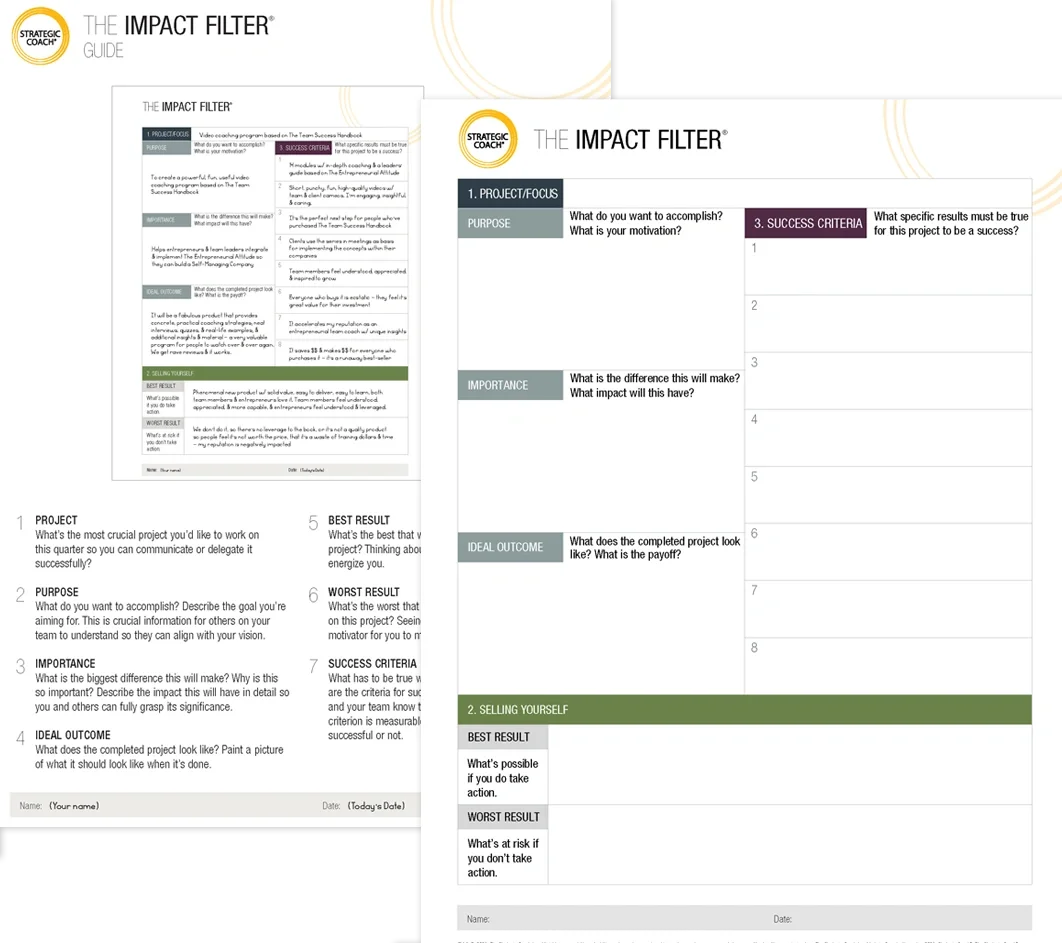
The Impact Filter®
Dan Sullivan’s #1 Thinking Tool
Are you tired of feeling overwhelmed by your goals? The Impact Filter is a powerful planning tool that can help you find clarity and focus. It’s a thinking process that filters out everything except the impact you want to have, and it’s the same tool that Dan Sullivan uses in every meeting.