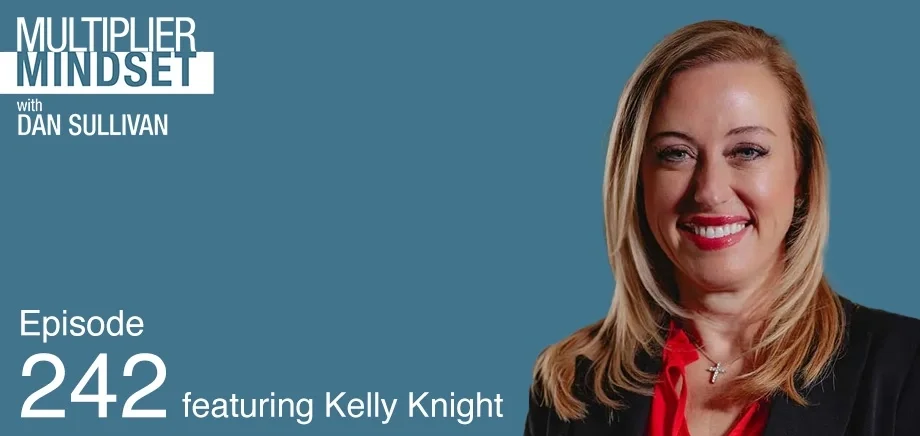
The Secret Behind Every Great Entrepreneurial System, with Kelly Knight
December 03, 2025
Hosted By
 Dan Sullivan
Ever wonder what sets thriving businesses apart? In this episode, Dan Sullivan and Kelly Knight share how strong company systems and personal growth go hand in hand for entrepreneurs. Learn why finding the right people, embracing risks, and focusing on core values lets you solve almost any problem—and why successful companies and individuals both need solid operating systems to keep growing.
Here’s some of what you’ll learn in this episode:
- Where Strategic Coach® and EOS® complement each other rather than overlap.
- How Kelly built on EOS’s Strategic Coach legacy.
- Why EOS is personally meaningful to Kelly.
- How top entrepreneurs turn mistakes into momentum.
- What Kelly sees as the number one issue facing entrepreneurs today.
- Keys to keeping your company laser-focused.
- How EOS Worldwide faced (and survived) a pivotal crisis.
- The game-changing impact of Kelly’s Strategic Coach experience.
Show Notes:
An entrepreneur needs two key operating systems—one for running the company and one for running their own life and personal growth.
Your passion is often the secret ingredient for long-term success because it’s what sets you apart—and keeps you moving.
Growth comes from leaning into risks and staying open to new possibilities.
You can’t win every time, but you’ll learn more from setbacks than from any formal education.
Don’t waste time worrying about what might go wrong in the future; stay focused on what you can control now.
Turning losses into recoveries energizes your team and inspires loyalty.
Rapid growth always brings new challenges; expect change and meet it head on.
Finding your people—the team that truly shares your values—is an ongoing process worth obsessing over.
When you put the right people in the right seats, everything else in your company starts to click.
Resources:
Thinking About Your Thinking by Dan Sullivan
Episode Transcript
Dan Sullivan: Hi, this is Dan Sullivan. I'd like to welcome you to the Multiplier Mindset Podcast. Today's episode really combines a lot of things. And this is with Kelly Knight, who's the worldwide Integrator for an organization called Entrepreneurial Operating System. And this has got a real history with Strategic Coach because the creator of the Entrepreneurial Operating System, Gino Wickman, and Gino has closing in on 30 years he's been in Strategic Coach, and he continually informed me that he was creating a coaching program within our coaching program. So he was using our coaching program to create his own coaching program and he was very transparent about what he was doing and every time he would come to his workshop he would talk about his progress and along the way we developed a parallel future for our company and for EOS. We talked about it and we began to realize that we were two operating systems and that entrepreneurs actually need a lot of operating systems.
But the two most important operating systems is the operating system for the entrepreneur themselves as a single individual. And this involves your whole life, it's your business life, it's your personal life. And the other operating system you need is so that you have tremendous organizational structure and process in your company. And what Gino was taking on was something that we will never do in The Strategic Coach. Our focus is always on the entrepreneur as a unique individual, what their Unique Abilities are, and then the structure of who's really skilled, who's around them that allow them to constantly be the leader and not caught up in the management of their own company, so that the company is there as a vehicle that frees the entrepreneur up to actually go out and create a much bigger future for the company.
Then at a certain point, Gino felt that he had created a really great company, but he wanted to go on and do different things for himself. And he's very passionate about bringing along young people to become entrepreneurial thinking. And this is his passion in life. So he sold the company. So the two main individuals are Kelly Knight and Mark O'Donnell. And Mark is the Visionary for the company. And Kelly's the person who makes sure that all the parts fit together. And they have hundreds and hundreds of Implementers who go out and coach all the clients who are learning how to implement the Entrepreneurial Operating System. So it's rather unique because usually when you have a coaching company and they start, they don't want there to be other coaching companies. They want to be the whole coaching company. So they keep creating new programs to handle everything else in the entrepreneur's universe.
My attitude is that that's the wrong way to go and the right way to go is just find out what your company does best in the coaching world and become really great at that and then see if there's other coaching companies who are of great value. It would be great value to your own clients, but be very, very clear that we're just for the entrepreneur, just the single individual. Frequently, in most cases, they created the company just like Gino did. And we want that person to be continually freed up just to create more and more ambitious possibilities for their company, create new capabilities, but then there's got to be other coaching companies who handle the whole aspect of, what does the management look like? How do you maximize your present capabilities while the entrepreneur is out creating new possibilities? This has been marvelous.
Another example of that is our collaboration with a wonderful coaching organization called Genius Network with Joe Polish, and that's been going for more than 20 years. And Joe's the master of marketing, so he's got a whole coaching program on how you market, how you turn every aspect of your company into a positive energy that markets the uniqueness of your company out in the marketplace. And hundreds of our clients have gone to Genius Network, but hundreds of our clients are also using the Entrepreneurial Operating System. And so together we have three companies and others will present themselves as they go along. But the thing is that all of these collaborations actually start off with the entrepreneur being at Strategic Coach.
So Kelly's just a delight to work with. Mark is a delight to work with. I said to them when we started the formal collaboration where we said great things about them and they say great things about us. Our people go to their program, their people come to our program. And I said to him, let's try it out for 25 years and see how it works. So we're about five years in now, and it's working just superbly. But I see this as the real future of entrepreneurism. You don't try to do everything in the marketplace, you just pick your spot, get better and better at it, and then surround yourself with other people who are just passionate about what they're doing. You don't have to worry about developing their side of the activity, they don't have to worry about developing your side of the activity. So I think this is the way the future is going to go, so I'm so pleased to, you know, add my dimension to this interview with Kelly Knight. She's just got a wonderful spirit about her. And we're so happy just to make sure that her story gets out to all of the people who are involved in the Strategic Coach universe.
Kelly Knight: I am Kelly Knight. I am the President and Integrator of EOS Worldwide, which stands for Entrepreneurial Operating System. Some of you may be familiar with that. It's a simple, practical system for helping entrepreneurs get everything they want from their business. We've been long-time collaborative partners with Strategic Coach predating my being the Integrator for the past 10 years. It's really Dan Sullivan and Gino Wickman partnered many years ago, and so I'm grateful to have that continued relationship with Strategic Coach and Dan Sullivan today. I live most of the time in Michigan, about an hour north of Detroit in a little tiny town called Clarkston. It's where I grew up. It's where I've raised my three children. And we also have a second place, which is where I'm at today, that happens to be on the west side of Florida near the Gulf. So that's a little bit about me.
I love entrepreneurship. I've been doing that for all of my life, starting with when I was just a little girl, my dad being an entrepreneur himself and sitting at the kitchen table and crafting and drafting ideas together and figuring out how we would make them real. I spent a lot of my time in business in the financial services business. And while it was really fulfilling and interesting and exciting, there came a point at which I had done what I had come to do and was kind of bored, honestly. And I was sort of speaking to the universe, talking to God and saying, I don't know what my next thing is, but I promise I'll follow anything that comes my way. And it was six weeks later that I got a call from EOS, from the recruiter, who was looking for the next person, the successor to Gino and Don's plan here at EOS Worldwide. They're the founding members, Gino Wickman and Don Tinney. And so they were looking for who is going to run this business, who is going to take this over and be the partner to, at the time, was Mike Payton, the Visionary and Integrator.
So I was intrigued by the opportunity, one, because it was just so completely different than everything that I had done for 18 years prior. And it really was fundamentally about making a huge impact in the world through entrepreneurship, which is something that was near and dear to my heart. I felt like I had gotten away from that a little bit and gotten too into the corporate space. And I wanted to get back to the roots of truly growing an organization that at its heart serves entrepreneurs. We are entrepreneurial at EOS Worldwide, but we serve entrepreneurs. And so that to me was so enticing and sort of addictive to get back into that space and to serve entrepreneurs. So that's really what had that like left turn on my kind of business intentions and my entrepreneurial thirst for new and different.
I'm connected to so many amazing entrepreneurs and they're all of different flavors, you know, candidly. I mean, there's lots of different ways that you can explore entrepreneurship and be successful. I would say what's common amongst all of those different flavors, though, is a passion for something. It's rooted in something that you care about, you see value in it, it's gonna change the world, even in its own way, directly or indirectly. I would say the other component is you're willing to take risks. You're willing to try things other people simply aren't because, you know, being a person who's willing to take risks, it means that there's sometimes a downside. There's things that come with it that can be detrimental to families and things like that when you're talking about finances. But entrepreneurs are willing to take that risk, to go to the edge, to jump off the edge of that cliff and to try it, succeed, fail, try again, succeed, and just keep iterating over and over and over again. So that risk profile, I would say, is one that is an important component to entrepreneurs who actually win eventually.
You know, as Dan Sullivan will say, sometimes you're on the learning team or the winning team, and that's the thing that entrepreneurs are able to understand and grasp really well. And the learnings are worth so much. They're worth more than any education, in my opinion, that you can get anywhere, because those are what help you to not make those same mistakes. We're always going to make other mistakes. Those are future things. You know, we don't borrow worry from the future. We just say, okay, this is what I've learned from this. What can I take to fuel where that now takes me in a new or different direction, or to improve the direction in which we're going? So, so long as we learn from those mistakes and we use it to cultivate the future, it's hugely valuable. And sometimes we get a lot further by the mistakes having been made than if we hadn't made those mistakes, because sometimes it ignites a curiosity to try something more creatively than would have been the case if we had continued to go down the first path.
So, I like to think that you know, any mistakes that we've made at EOS Worldwide or that I've made have made me just a better leader, a better entrepreneur, a better thinker, more creative, and again, more willing to take risks. Because when you lose and you recover, everybody loves the recovery. And that actually has an energy associated to it that I think is important for driving human energy, getting everybody around us as entrepreneurs, because we don't go it alone. We go with a team. So some of that can be kind of like an electricity that keeps things moving. We at EOS Worldwide, we're growing a whole lot and growing quickly. Our Implementer community, Implementers are business coaches who help leadership teams and entrepreneurs get what they want from their business. So our Implementers, our coaches, we're growing really rapidly all around the world. And that's a good thing. But with growth comes some challenges, too. And so there was kind of like a fraction inside of our Implementer community that became cancerous, meaning, you know, if you don't have alignment amongst everybody with a vision of where an organization is going, it's ripe for issues that can spike up internally. So you can't have a vision inside of a vision and achieve that common alignment because there's different sets of directives, different people who want different things.
And so there was an Implementer inside EOS who wanted to go a different direction and was kind of channeling other Implementers to go that way. And it created divisiveness amongst our community of Implementers. And so to me, a person who wants harmony, wants everybody to be really growing together, that, I realized, was going to be devastating to the organization. So we needed to make a change that was basically exit anybody who doesn't share our core values, who doesn't share our vision. And to protect EOS worldwide, we'd been a membership model, which had worked very well for many, many years. But when it came to this fracture, we said, we're going to create standards and consistency amongst who we are, who we bring into the community, how we operate together. And that's when we went to a franchise model.
So it was risky in the sense that there were plenty of Implementers who could have just walked away and said, listen, I don't want to go through all that change. I don't want to go through … I like the way that it was. I'd rather go do something else rather than go through the headache of, you know, legal franchise-related stuff. But I do believe because we built a franchise that is fundamentally based on the same principles, as way back in the day when Gino and Don had created EOS, it's abundance-minded, there's no territories, there's no royalties. We created something that protected EOS and gave the same path forward for freedom for our Implementer community. So we took something that was really pretty dangerous, could have ruined the company, taken it down, and we just said, you know what, let's pivot this just a little bit. Let's protect it and let's take the opportunity to hit the reset button Anybody who doesn't have shared beliefs or values and all of that, that's okay. We'll love you anyway. Go off and do your own thing, but we're gonna continue with a very focused approach the same way that we've wanted to do since the beginning of time.
So it was one of those defining moments, I would say, where we really could have just sort of fallen apart and we stood up for what we believed in and our principles and it all worked out. 82% of Implementers came, the other ones decided to go do something else, and again, that's okay. You know, I'm so passionate about it. It's something that I work to instill amongst our leadership team and amongst our entire organization and amongst our Implementers is to be really focused and centered on those things. So we're watching out for words, actions, and behaviors that either exemplify those core values or words, actions, and behaviors that don't align with that, and then it becomes a very relational set of conversations with everybody.
So we say at EOS that stories and examples are a great way for learning, for people to understand, because often it's not intentional. There's lots of times maybe something's happening, we all need that gentle tap on the shoulder that doesn't emulate, as an example, help first, do the right thing, do what you say, grow or die. Those are some of our core values. So we take the approach that people's intentions are good. If we've hired well, we've gotten the right people to join the team. That's a reflection of core values that sometimes we all just need those gentle reminders. Sometimes, though, when it's consistent and say 80% of the time someone's not exhibiting our core values and we've gone through the process of talking it through, giving examples, and it's still repeating itself, that's the opportunity to say, this isn't working for us, this isn't a good match, it's probably not a good fit for you either, because as I like to say to team members, if you don't share our core values, I'm gonna drive you crazy, because I'm going to keep reiterating what those things are, the standards that we're looking for.
So it really truly is an obsession, it's a passion for it, it's being mindful, it's being intentional, watching for it, and then doing something about it. Your raving fans and those that adhere to the same values, they're everything to your business. And so I'm so honored that 82% stayed and felt like it, and still our retention rate is over 95% at EOS Worldwide year over year over year. So I take a lot of pride in that, that you can't go it alone. We never could have gone through that transition if it weren't for our advocates, those in our community who cared enough to stand up and help us to row through those really hard times. So the thing is, you just got to find your people and stick with your people and continue to support each other. And that's a journey. It's not only through transition, it's this ongoing process of finding your people, like-minded, who you're gonna support each other through all kinds of life's challenges. When we turn on the news, we see all kinds of things that could destroy organizations, but entrepreneurs see through that. And so long as we stay kind of united, strong and united, we can get through anything. So that's what I've learned.
So it's just another example of a testament that makes me believe so deeply in people and that it's at the foundation of getting through just about anything. The number one issue facing entrepreneurs are people. Getting the right people in the right seats, aligned with the focus of where we're going, a purpose, cause, or passion is always people. We see the root of all evil in organizations really stems from the accountability chart, which are people. So right people are those that thematically, as we've been talking today, right people are those that adhere consistently to our core values. Right seat is someone who has the get it, the want it, the capacity to do the role or the seat that they're in. And so that combination of getting right person with the core values in a right seat where they can perform well consistently is the singular most important thing to do and the hardest to consistently keep, you know, because it's constantly changing. It's a constantly changing matrix of humans.
So, say you have a team, you have 50 people on that team, say in a moment in time, all of them, let's pretend like all of them were right people in the right seats, what do we know to be true in life? Everything changes. Companies change, so the type of people they need in organizations will change. Individuals change, so I change. I'm not the same that I was five years ago, and my wants are different today than they would have been back then. So it's what I call the constantly changing matrix. And as an Integrator, I've got to be thinking about what all is changing as it relates to the people plan. So that's the number one. Number one is people. Sales is always challenging, trying to get the right sales in the right places with the right target market, I would say, is the second one that I would speak to a lot. And then the third would be data, is how do we acquire data? How do we use data? How do we leverage data for the purpose of driving our organizations?
But you can hear in me the number one. That's the one that if you just obsess about people, you're going to solve most of the problems in your organization. Because right people are going to solve data issues. They're going to solve sales issues. They're going to solve process issues. But without the right people and technology, you won't be able to get there. If you're looking to get right people in the right seats, have a process for it. Define your unique process for finding the right people to come into your organization. So a lot of it boils down to process and creating the standards. So the standards for your core values, define what those are, the attributes and attitudes that most exemplify who you want to see in your organization and be true to those as you're recruiting. Don't try to sell yourself that that person's going to learn those things and be true about it. So stick to that. And then be really, really clear about the expectations of the seat. Why you're hiring someone? What are they meant to do? What are they meant to accomplish? And what do you need to be true about that individual for them to be successful?
So if you do those two things for right person, right seat, you're going to attract great talent. Here's the thing, too. When you get this right, it takes a little bit of time, so you have to be patient with yourself and with the process, but when you get it right and you begin to build a culture that is attractive, that is working, you're successful, people are happy, they like to be there, they like to learn there. That gets out into the world and pretty soon you have a lineup of people who can't wait to work for you. And then you're just this magnet for incredible talent. Sometimes I look around at EOS Worldwide and I think I'm luckier than I deserve. I have people coming from amazing places and I'm like, how did I get so lucky to get these people? So that's kind of the way that I've experienced it.
And so my urging is be patient with the process, but create a very clear process, stick to it, be consistent. Consistency is very key. And pretty soon, all of a sudden you just, the right talent is coming to you at the right time. I'm in Coach because it provides me such a luxury of being able to be with other like-minded entrepreneurs who understand my perspective. I don't feel so alone when I am in Strategic Coach, and it gives me the opportunity to be totally immersed in the tools and thinking about my thinking, and also the collaboration that comes from the Free Zone capabilities that are there. So it's an opportunity to slow down, think about my thinking, to be with others who think like I think, and to be able to collaborate and think about how can we help each other and do some pretty amazing things in the world that would otherwise probably never come together. Where else would I meet these individuals but for at Strategic Coach?
And the relationship between EOS and Strategic Coach has always been so hand-in-glove. It's easy, effortless, fun, supportive. And again, that predates me because Dan Sullivan and Gino Wickman, 25 years ago, were together in Strategic Coach. Gino was in the Program in the very early formative days. And as Gino sold EOS Worldwide, it seemed also really natural that as I became sort of the lucky beneficiary of running and managing EOS Worldwide, that I would carry the torch and really begin to delve into it myself. Because Strategic Coach is the operating system for the entrepreneur, EOS is the operating system for the company, the business, the leadership team. It's just a very natural fit. And so being part of that really has helped my journey so much. I think I'm a much better, stronger entrepreneur, more creative thinker, more open. It's just been such a delight.
I said to Dan at our last workshop last week in Chicago, it's such a joy to be here. I literally look forward to coming and just sinking into it and having dedicated time with my people. Many people over the last decade that I've been here have said, what was the unexpected great? What's the thing you didn't know about EOS that you now can say? And the thing that I did know is that EOS helps entrepreneurs get what they want from their business. What I didn't really understand is the legs and the reach of EOS, so when an entrepreneur and their leadership team implement EOS, it goes to their families, it goes to their network. All of the tools and the thinking, all of that has greater legs than you can ever imagine, and it really does change people's lives. I know that might sound really trite, super simple maybe, but it helps people to communicate better, to solve issues better, faster, to get on the same page, to create alignment.
So I just didn't know that it would have that kind of reach beyond just the team. And it's like the magic combination, you know, the pairing of EOS and Strategic Coach together is this magic formula for me. And I can't imagine not having one without the other. One of the two is awesome. Both for me is just perfection. So it's pretty cool. It's amazing when you find the right people and the right tools and program to support you as an entrepreneur, but also personally too. And we like to think we compartmentalize those things, but they're really all in one. Just the natural collaboration that's born out of conversation and the close relationships that I have with so many of the people that I'm with. I mean, I think of them as my close friends now. It's not just part of a peer group. There's lots of peer groups in the world. This is above and beyond anything like that that I've ever seen or been a part of. So that's very, very special, the relationships.
And I have said this to many people who were in 10x, I will say, just do it. Like the Nike slogan, just do it, because that next step up—10x is great. I still love attending 10x. That next level up is just mind blowing the creativity. It's like blowing the lid off of something and it becomes limitless. That's what Free Zone is. It's like the limitless version of Strategic Coach and those that are in that program are of that same mindset. So if you really want to take yourself to become the limitless version you're meant to be, that your Unique Ability is meant to become, that's where it occurs is in Free Zone. From my perspective, because I've been part of all the programs, I was in Signature and then in 10x and then in Free Zone.
Okay, so 10x is an elevated form of the tool set. So, you know, I think of the Signature Program as your baseline, you're getting the foundation set. 10x is beginning to expand the way that you're using the tools and how they work together. I've often said that in 10x, it's like you see the Strategic Coach tools come together like Legos would be for kids. You begin to put them together and layer the tools to begin to advance your thinking about your thinking. And then the next level would be the Free Zone, which is this hyper-focused, collaborative, support each other on multi, multi levels that is beyond, beyond 10x. So if you've got kids and you've got training wheels, it would be like where 10x is you're running behind the bike still holding on. And then when you let go and release, that would be the, you know, you're fully riding that bike and having so much fun and you're untethered from anything else. So there's my like kindergarten version of it for you, Suvi.
And then there's the, you know, those that are a little more familiar with Strategic Coach probably understand the first version. It's so interesting because I was just at an event separate from Strategic Coach. I was at a different event and an EOS Implementer came up to me and said, thank you. Your advice really helped me. And I said, well, what advice was that? He said, you said to me when I was in Signature and I was thinking about taking a break, not renewing and going in the next year, you said to me, please stick with it one more year because. For those that are high Quick Start, for those that know Kolbe, high Quick Start folks like a lot of change. It's hard to kind of stick with things sometimes. So if you're thinking about Strategic Coach and going into Signature, which is where everybody starts now, it's foundational. So please remember that even though it might go a little slower than your pace of your natural Kolbe, it's important to stay with it because that foundation will make you that much more richly capable of taking advantage of those next layers up of 10x and Free Zone.
So my biggest piece of advice is A, just do it. Just get into the Program. You will see the benefits. And two, stick with it. Be patient through that first year to get through some of the foundational materials so that, again, you're going to flourish and see the full value of everything that Strategic Coach offers. We have lots of free accessible tools, downloadable and otherwise at eosworldwide.com. You could also go to eosone.com and that will get you to our software platform as well. And otherwise connect with me on LinkedIn at Kelly P. Knight and I'd be happy to connect you with the right resources, whatever that is that might support you and your business. I'd love everybody to connect with me. I am very much a connector myself, if I can help you.
If you have any questions that you want to hear from me offline over this, please, again, just reach out to me. Best is on LinkedIn, Kelly P. Knight. We have lots of free accessible tools, downloadable and otherwise, at eosworldwide.com. You could also go to eosone.com, and that will get you to our software platform as well, and otherwise connect with me on LinkedIn at Kelly P. Knight, and I'd be happy to connect you with the right resources, whatever that is that might support you and your business. Look forward to seeing you there.
Related Content

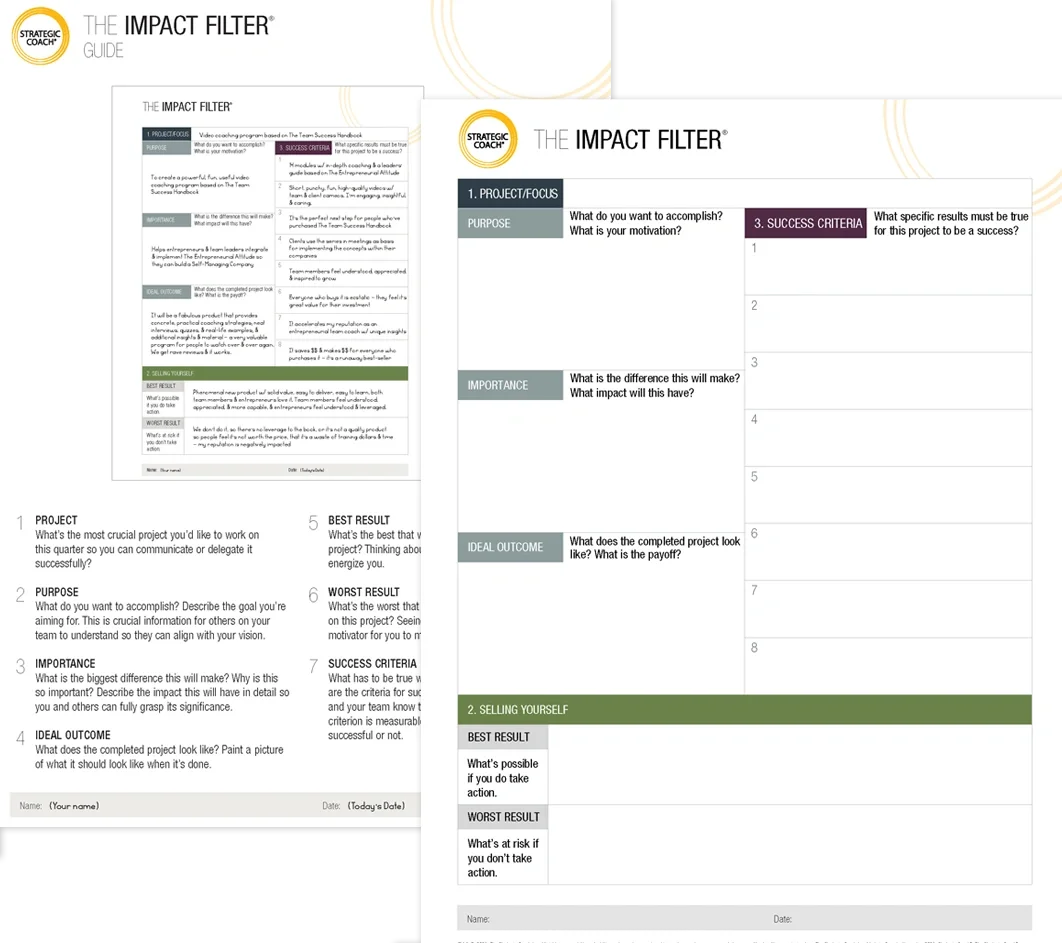
The Impact Filter®
Dan Sullivan’s #1 Thinking Tool
Are you tired of feeling overwhelmed by your goals? The Impact Filter is a powerful planning tool that can help you find clarity and focus. It’s a thinking process that filters out everything except the impact you want to have, and it’s the same tool that Dan Sullivan uses in every meeting.