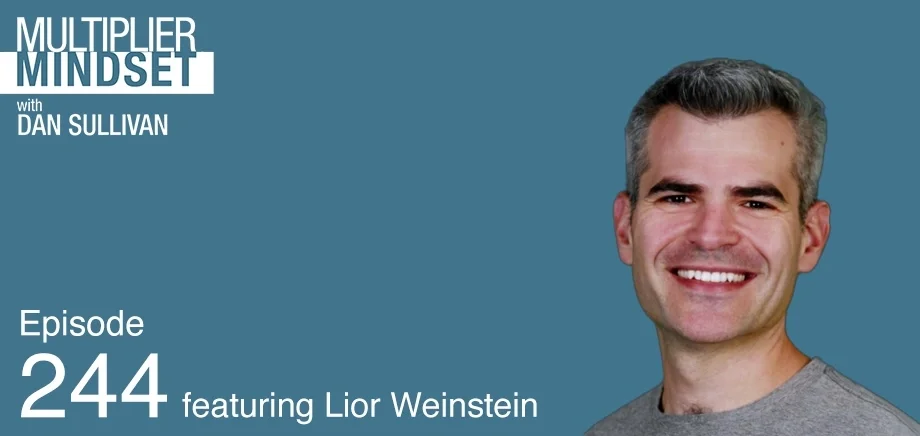
The Moment You Decide To Build Around What You Love, with Lior Weinstein
January 14, 2026
Hosted By
 Dan Sullivan
If you’re good or great at everything you do, it can be hard to focus on the one thing you really should be doing. In this episode, Lior Weinstein shares how he learned to identify and strengthen what’s most important to him in both his business life and his personal life.
Here’s some of what you’ll learn in this episode:
- How Lior’s entrepreneurism showed up when he was still in grade school.
- The mindsets Lior gained from growing up in Israel.
- What drew Lior to move from Israel to the U.S.
- Why having a child led to Lior struggling as an entrepreneur.
- The particular freedom that Lior is always working to expand.
- What happens when entrepreneurs have space, and what happens when they don’t.
Show Notes:
You’re born with a Unique Ability®—the activity you’re energetically drawn toward and can’t get enough of doing.
Being good—or even exceptional—at something doesn’t automatically make it emotionally fulfilling.
If you’re a non-entrepreneur, someone else owns your time and controls your activity.
There’s a common misconception that entrepreneurs are motivated only by money.
The “Four Freedoms” that entrepreneurs seek are freedom of time, money, relationship, and purpose.
Struggling as a parent isn’t a sign of failure—it’s a sign that you care deeply.
What looks like quitting from the outside may simply be the decision to choose a different path.
If you’re reflecting on a bad decision, that means you survived it.
Entrepreneurs often underestimate the value of their own intuition.
If you have the money to solve the problem, you don’t have the problem.
Resources:
“The 4 Freedoms That Motivate Successful Entrepreneurs”
Who Not How by Dan Sullivan with Dr. Benjamin Hardy
Episode Transcript
Dan Sullivan: Hi, this is Dan Sullivan. I'd like to welcome you to the Multiplier Mindset podcast. On today's episode of Multiplier Mindset, it's a great pleasure for me because I'm commenting on some great insights by Lior Weinstein. And Lior lives in Austin, Texas, but originally born in Israel. There's so many different aspects of entrepreneurism that Lior comments on. He's very, very insightful. He's a very deep thinker. And he's a joy to have in Strategic Coach. I want to tell a little story about Lior. So he came into Strategic Coach Program. I was his coach, but I was coaching 50, 60 individuals and lots of times takes a while for you to really connect with the ones that you're really supposed to connect with. But I remember the first time I talked to Lior, he gave me his history. He was finished sort of giving a very quick overview of how he had gotten to where he was, born in Israel but living in the United States. And I said, Lior, I just want to ask you a couple of questions. One, when you were young, you were grade school. Did your parents comment to other parents, you know, Lior is amazing, Lior can do anything? And he said, yes, they did. And I said, when your teachers talked to your parents, did they say things like, I wish all my students were like Lior because Lior can do anything? And they said, yes, they did. And I said, Lior, that's your biggest weakness. You can do anything, but you have a hard time focusing on the one thing that's really, really great.
And I like to use that as a jumping off point. In Strategic Coach, we have a concept of Unique Ability. And Unique Ability is you're born with it. It's not something that you learn in school. It's not part of your growing up. It's just something that you have. You're just energetically drawn to this type of activity. It's a particular way of operating in the world. And to point out how special it is, in Strategic Coach, we have a way of people identifying four levels of activity, one where they're incompetent, you know, they're just no good at it. For me, for example, I can do really high detail work for about two hours, and then I'm worn out from detail work for a month. Okay, so I'm incompetent at it. You would never want Dan in a situation where you had to depend on him for getting the details right. Number two is where you're competent. By the standards of the world, you're good enough. But it takes lots of work, and it really wears you out. But you're good enough, you know. Nothing special, but you're good. Number four, you're excellent. You're way above. You do this, you're excellent. You do this, you're excellent. You're doing this, excellent. But excellent is not Unique Ability because it's not emotionally rewarding enough for you, okay?
Unique Ability, when you're in your Unique Ability, and this is the number one concept in Strategic Coach, is Unique Ability. Everything else in Strategic Coach, we have hundreds of thinking tools, but Unique Ability is number one. There's a way of you focusing yourself and organizing your activity in such a way that you're doing something that gives you more energy than it takes. So if you did it all day, you would have more energy at the end of the day than you did at the beginning of the day. You can't get enough of this. Most people in life don't have the ability to operate this way because somebody else owns their time, somebody else controls their activity. So that's why entrepreneurs become entrepreneurs. Entrepreneurs are the individuals who are most in pursuit of the one thing that's their Unique Ability. And then they want to organize a structure around it so that more and more every day they have the freedom and the full focus that they can be in their Unique Ability. And this is where they really impress other people. This is where they have a great impact on other people when they're in their Unique Ability.
So, back to Lior, I said, you know, what's really great about you being in Unique Ability, I think you're excellent at everything you put your mind to. I doubt, Lior, that you could come across a new subject or a new topic or a new activity where you wouldn't be excellent at it in a short period of time. It's not your Unique Ability. And what I'm happy in the interview that Suvi did with Lior is that he actually said what his Unique Ability is. And his Unique Ability is the optimizing of his freedom of relationship, okay. So he's actually identified and put into words what it is. So that means in any situation that he's in, his goal is to have the freedom of the fullest possible relationship with who he's working. This is in his business life. This is in his personal life. But what he's doing is that he's optimizing that. And it really delights me. And all those other skills he has, all the other interests he has, that all adds to what he can do when he's optimizing his freedom of relationship.
So there's a misunderstanding by entrepreneurs in the world that's not entrepreneurial, and that is the only thing that entrepreneurs are interested in is money. They only do it for money. I'll say that this actually shows up very early in an entrepreneur's life. Lior's talking about he was already involved in the stock market when he was in third grade. He was already creating a company when he was 14. And people say, see, he's just after money. No, he's after freedom. And what entrepreneurs discover really early is that you have to buy freedom. You have to buy freedom. So in Coach, we have four freedoms. We have freedom of time. You have to get freedom of time so that you can get freedom of money. The moment you get freedom of money, you can get freedom of relationship, because you can buy your time back, you can set up the conditions, freedom of relationship. And once you have the three freedoms of time, money, and relationship, then you can have freedom of purpose, that everything you're doing in life is for a central purpose. Okay, it's your uniqueness growing and producing bigger and bigger impact in the world, in your personal life, in your business life.
And it's such a pleasure. I was like a master class listening to Lior. It's a marvelous conversation for other entrepreneurs to listen to because I bet as you're listening to Lior talking, you're saying, yep. Yep, that's me. Yep, that's me. That's me. So I'm very, very thankful that Lior gave us his time and that Suvi Su, our great, great video manager, that she captured the opportunity so that many, many other entrepreneurs in the world can enjoy Lior's great insights into what it means to be an entrepreneur.
Lior Weinstein: My name is Lior Weinstein. I now live in Austin, Texas. I am an entrepreneur. I run multiple businesses and I work as a fractional chief technology officer or as a fractional chief growth officer for companies that are 20 to $100 million in revenue. And I do it mostly on a partnership model, so like whatever value we create together. And I also own a business that teaches other CTOs how to be fractional CTOs. I first known that I was an entrepreneur, I think it's more reflective. I don't think I had the label in real time, but I've always like, I've started trading stocks when I was in third grade or fourth grade. So I was always interested in doing, you know, even in primary school, elementary school, I was creating the class newsletter and organizing, you know, different people, you write the comic book section, you do the game cheat codes, you do the funny stories, right? Meaning I was always, from a very early age, kind of organizing something towards a vision that I want created. And I also dabbled with money stuff at a pretty early age. My first actual business, I started at 14. So the actual limited liability company, and that business created games for digital TV receivers.
So this is the same era as PlayStation came out, TiVo came out, so suddenly TV started becoming smart. And I grew up in Israel and that was the time where digital TV receivers came in. And I had this vision of we can create games for this. Again, I cobbled a couple of friends that were great, like designers and coders. And we basically did that for a couple of years. We made at the time, trying to think about the exchange rate, but something that would today be, well, in today's dollars, it's probably more close to like a thousand bucks a month, or maybe $1,500 a month, like a lot of money for a 14 year old, you know, at the time. So that was my first like actual business LLC, making money, negotiating prices, you know, things like that.
So at the time my father was subscribed to kind of old school newspaper, right? And I don't know how it was in the U.S., I'm sure it had some parallel, but at the back of the newspaper, it had all the stickers, all the symbols or all the company names and their last trade, their last price, their closing price. My neighbor had at the time a T1 line, which is, you know, a fast internet connection directly to the stock exchange. And he was trading and I asked him if I can trade with him and teach me out. And I just learned how to look at the thing every day and understand what was going on and then putting some orders with him, obviously small money. One, I think kids are fascinated with money. I see it with my kids now. It's like, they always want to buy something, make something, you know, money is a fascinating thing for kids. And I think because I had that exposure of seeing the company list and the stock prices every day for years as a kid, I just like, hmm, this caught my attention. And I always had the so what, like doing something about something that I want to have happened. And it just unfolded.
So years later, professionally, I became a high frequency algorithm developer for a large hedge fund in Israel. And I still own one of my businesses, a student algo trading company, a prop trading firm, meaning it's proprietary, it's our own money, our own technology. So I'm still in, technically, like, it's still there, but it's not a business interest of mine, like other things that I like more on the creative side. So I grew up in a small town called Evin Yehuda, which is next to a big city called Netanya. So Israel has a few of these kind of large cities, Netanya is one of them. And it's about 25 minutes, 20 minutes north of Tel Aviv, like as a, you know, so it's central Israel, pretty close to the coastline. And I moved to the States just before my 26th birthday. So actually 25 and a half, that's exactly what it was. And I moved with my wife and we've been together for nearly 19 years at this point.
So we met in Israel and I always loved the U.S. I've always done business with the U.S. and it always kind of felt a place like one of those homesick to a place I've never been. I've visited the U.S. many times, but I haven't lived. And it was a great move. Like as soon as we landed, we lived in Atlanta, Georgia for 14 years before we moved to Austin, which was great. We had a great experience. And then we decided to move to Austin because of the community. And now it's just, you know, how the ages kind of how life changes as you age. Growing up in Israel is very different. I guess anywhere is, you know, different, but certainly it's different than what people know here in the U.S. The Middle East is very unique in how it operates. For me, I got a ton out of it. You know, there's a lot of mindset stuff that you get culturally that are invaluable, certainly when it comes to business and entrepreneurship. It's a country that has an active military and active, unfortunately, sometimes active war zones. And it's a very small country and it's a new country. So all of these things kind of force you to fight one way or another, which also means it's fairly difficult to do business in this world. So there's a lot of these like, you know, challenging mindsets to work with. And at the same time, it polishes you really well, right? It's kind of a sword sharpening sword thing.
So that's why you see it when let's say you meet a 21-year-old Israeli, they feel like in comparison to a 35-year-old American from a maturity perspective, because just more things happen emotionally at a young age. And I leverage all of that. I leverage all of that. When I was a kid, I leverage all of that. When I was adult, I still leverage it, because my sense of adversity is fairly developed. I know the value of it. I have a lot of things in my past I can rely on to get me through present moments. It's really great. I wish I could give it to my kids and at the same time I'm very glad that my kids are growing up here. So I became a dad in 2016 and I have three kids now. So by the time I was a dad, I already sold multiple companies and I went through a lot, like a lot of different things. Also very kind of elaborate military career and just a lot of things.
So when I became a dad, about a year after I joined the first start-up that I didn't start, like it was the first time I joined a business. I was number two and I was like a board member and an equity holder and the whole thing, but it wasn't my original vision. Right. That was the first time I was struggling between my former behaviors as an entrepreneur, which, I'm a very positive guy. I'm not like whatever you're hearing on the podcast. If you hear a podcast from me 10 years ago, it's the same person, right? So you're not going to like see a different demeanor or something like that. But I was used to working 18 hours a day because I loved it. I loved it and I was great at it. So it didn't bother me and it was great. But then suddenly, I'm in this situation where one, I was also commuting, which was also a whole thing like getting into a car and driving to an office and then leading a team inside an office and then driving back and suddenly I'm 7 p.m., 8 p.m. back home and have a baby.
And then that's where my struggles actually began as an entrepreneur. This dichotomy between how I'm used to metabolizing business and my work and my labor and being a dad and connecting with those emotions. I always kind of tell parents to struggle with it. The reason why you struggle is because you care. If I wasn't a father that cared about his kids, then this would have been very easy. I would have just continued gung-ho 18 hours a day. Easy peasy, but I'm not, I care a lot. So that's the first time I had a struggle to the point where the company grew a lot. We raised almost $40 million and a few million active monthly users. It was a whole thing. Raised big Silicon Valley money. And I distinctly remember there was a board meeting about a year and a half in, almost two years in, and the board wanted to take the company to a direction that I just didn't care about, meaning it was just not something that I really wanted to do. I understood the reasoning, I understood the logic, but I couldn't connect it emotionally to the vision that they were fabricating. And at the same time, my second son was about to be born. And I made this decision. I'm like, I realized, oh wait, I don't want to go through this business vision, this transformation. And it's always hard with newer businesses because that's where all the energy, all the lift energy you need to kind of create, right? You need to get it off the ground and do this again and have like a young baby and not being able to, to that, not to him or for me.
So that was my first, like, oh, I'm going to leave. Like, I'm going to quit, which I've never done. Historically, I was just a bulldog. I'd for sure fail, but I didn't quit. And that was the first time I had to go through this, well, I'm not quitting, I'm choosing something else. And I'm choosing a non-business route, which was a great decision. We ended up doing, we're a big RV family, we love to travel together. We also, now we homeschool our kids and we travel a lot with them. So we RV for months. And actually in that period of time, in my break, I was listening to all of Dan's podcasts and Dan and Shannon were like in my ear for months to the point summer came and I told my wife, I should really figure out what I'm going to do next. Our kid was like nine months old. And I remember, I think there's a business behind this Strategic Coach thing, you know? So I went to the website, filled out a form, connected with Amelia, one of our most favorite account execs and coach. Three weeks later, I was in Toronto with Dan and the rest.
I mean, definitely one of the most profound and important decisions I've made in my personal and professional life to join. And it came from having that space to say, I'm going to focus on me and stuff that I care about through a lens of lifetime rather through a lens of balance sheet. One of my most favorite Dan models from the past year is Decision/Indecision. And the basic mental model there is whatever bad decisions you had, and anybody should kind of look at the exercise and the tool, whatever bad decision you've had, if you kind of reflect back and look at all the decisions you thought were bad decisions at the time, hindsight is always 20-20. So you need to kind of go back to the point of decision and think, I think this is going to be a bad decision or a difficult decision or whatever. And when you reflect back on them, you realize as an entrepreneur, you recovered 100% of the time.
One, the very fact you're filling the tool means you didn't die. So it's already positive. Like whatever the thing is, you survived it physically. And also mentally, if you can fill out a PDF. So one, reflecting back on all these decisions and just realizing that you can recover from bad decisions. But then when you make a list of all your indecisions, and how much you have right now in your life and how much you've had in the past, and you see the emotions that it invokes, it's across the board. Like I've done it multiple times and I've done it in a room of other, you know, amazing Coach entrepreneurs, same themes, stress, anxiety, frustration, anger, right? Confusion, right? All these emotions that get you nowhere, absolutely nowhere, unless you process them to something. So one, making a decision, if you think it's bad, you're going to recover from it a hundred percent of the time. And the cost of indecision emotionally is just dramatic and not worth it.
One of my favorite mental models, which is what I used to make that particular decision when my second son was about to be born, was the path of least regret. And that is to say you have two options and you think you might regret, okay, meaning I would have regretted and probably regretted to stay and probably regretted to quit, right? Because I lose equity, I lose upside, whatever. So kind of recognizing it, that regret might come, but then choose the one that you're going to regret the least. Meaning if you're projecting yourself into the future and you're looking back, are you going to be happy that you took that particular chance, that particular decisions more than the other one, which is exactly what I did. And luckily for me, I was dead right. I think that was a great thing. I also find there's something about entrepreneurship, especially entrepreneurs have been around for a while. Our intuition is extremely valuable and we don't give it enough credit.
So there's like another similar mental model is I like to use and teach like people that are under me when I'm building leadership teams is the best time to fire someone is the first time you think about it. And the reason for that is, one, it rarely gets better. And I say rarely, I could say never and be absolute about it, but I have seen some turnaround, but it rarely gets better. It also, it never gets better than the interview, right? Like however somebody shows up in the interview, that's the romantic period. That's, you know, they're wearing makeup and they're happy. So however that guy showed up in the interview, if they're not great, they're not going to suddenly become great. But the reason why that's a mental model that resonates for a lot of people, like the actual reason, the underlying reason, is because you've been in business for a while. So by the time you get an intuition that you should let somebody go, it's not a fragment of an idea. It's actually weighted with decades of observations about people's behavior, which is why your subconscious or conscious mind kind of created this concept of maybe this person should leave. And of course, as an entrepreneur, by the time you see it, that means you're the last one that sees it. So everybody on the team felt it, you know, long before you.
So I think when people are faced with these big decisions on what to prioritize, Decision/Indecision, just acknowledge the fact that you can recover from what could be a bad decision and don't worry about it. And you have the skills to do it. The second is regret sucks. So regret eats you up, right? You see this in any age, certainly in old age where you just don't have enough time to course correct. You don't think, at least, you have time to course correct. So choose the path of least regret. If you're thinking right now to change the business, hire the person. I guess the last thing I would say, one of Dan's most expensive mental models for me is if you have the money to solve the problem, you don't have a problem. My wife absolutely loves that mental model. It's very expensive, but a lot of business problems can be solved with the Who Not How model. You're just thinking, oh, should I pay 90,000 or 150,000 or 200,000 for that person? Because you're thinking you want to get the price right. But what you're buying is your freedom, is the opportunity, is this vision of you changing your focus or going into your Unique Ability or whatever it is.
And people fixate too much on the ROI, about the role and the person and the salary and the list of tasks and the activity inventory and all that. And they're not focusing on creating space for themselves and acknowledging the fact that when entrepreneurs have space, a lot of great things happen. And when they don't have space, they're absolutely debilitated and debilitating to people around them. A lot of the learning happened post-mortem, right? It took courage at the time, but it was oblivious from like, I didn't have the option ready. I didn't know that I'm going to do this and this is going to appear, you know, option A or B is going to appear. And so—and I'm still refining it. What then I learned from them was the value of optimizing for freedom of relationship. and truly understanding the impact that other humans have. And these are humans you deal with in a room or in a zoo. Okay. It doesn't really matter. Like right now we're two people, two humans spending, you know, this precious time together and we're not going to get the time back. And at the end of this interview, hopefully I know I'm going to feel energized about it. So this was a good time, and hopefully you will have felt the same. And the more of those moments you have in a day or in a week, you have a pretty good life.
So for me, as soon as I got out of that environment, I could actually see the impact of what it's like to spend time with people that don't generate that effect for me, that actually get my nervous system also into defense mode. I'm still a nice guy, but Lior in defense is a very different guy than Lior on love. Right? I don't call out names. I don't, you know, but very different personality. It's way nicer to be next to me when I'm in the love frequency rather than, I mean, you know, putting all my defenses up. And you don't know because we're in 2020s. We're not talking about, you know, warring with spears and swords and rocks. So you don't know what's the equivalent. You don't know that you're actually fighting and you don't realize that somebody's throwing rocks at you, right? Energetically. And that was the biggest thing for me, just understanding, wow, there's so much value in filtering out, one, noticing and identifying, because I noticed there was something in my body that told me I don't want this. But taking that action of putting it into my awareness and saying this is worth an action, I should like pull the trigger.
So noticing and then pulling the trigger around decisions of that nature, meaning something that gets rid of certain people in your life and something that introduces certain people in your life. The big thing that I'm learning now is also the kind of Lior that I'm letting go and the kind of Lior that I'm inviting in. So the Lior that I let go was the defensive Lior, and the Lior that I'm inviting in is the dad Lior, right, like a dad to a baby and the lovingly or which I like way much. So it's not just, let's call it an air quotes, you know, easy decision of saying no asshole rule, no jackasses. That's easy. A lot of people dub that model but it's also very tricky, like yeah, I don't have any assholes, but it's way trickier to identify that somebody's actually draining energy from you when they're not an asshole. So just appreciating the value of your intuition and optimizing for the money ball of people around you. And if you look at your day or your week or your month or a year in that way, and you say, okay, what are all the people I'm playing with at any given point in time? And am I having a good time? Is it likely to create this personal environment where I feel inspired and thriving?
So that was the biggest thing for having seen the results and now being able to introspect about it and also retrospect about it, just like talk to people, and I also talk to people from that time period and kind of, you know, understand the changes. It's been invaluable and something I use all the time now. In fact, it's probably on the quarterly planning and monthly kind of meetings with my partners, it's probably the biggest thing on my mind at any given point in time. Which humans should we stop a relationship with, change a relationship with, and which humans should we create and expand a relationship with? Because Dan had developed hundreds of coaching tools and he's worked with entrepreneurs all of his life. He understands the entrepreneur psyche. The tools that you learn at Coach, you can use all day, every day. And I don't think I can say that about any other program. You can apply a tool on a billion-dollar problem or a $10 problem. And it's equally valuable to get you to the next shore of that problem. Like whatever that is. It's like island hopping with solutions and Coach is really good at that—both the environment, the team, the content, the coaches itself, the structure. It's really purpose-built and very big on structure leads function. And the way the structured Coach works is very aligned with entrepreneurs in a way that it's useful enough. So you can actually gain benefit from it and it's not burdensome enough.
So now you have to clear out a whole week, you know, it's its own challenges as life becomes complex and it's not overwhelming. every time so you can actually get something out of it. And that Goldilocks moment for coaching, and it is group coaching. It's not one-on-one coaching. One-on-one coaching is very different and it has its own values on great things. So for me, the experience has been great. It's my favorite recommendation and definitely some of my favorite moments throughout the year. And really just helps you being in touch with yourself. Like I said, nobody else can fill the tools for you, not even ChatGPT. And not a lot of programs allow you to do that, like investigate your own psyche with your own problems in a safe environment you can share and talk through. It's like a very good kind of therapy with a business orientation on the other end. But like anything, business is life. So a lot of the lessons you get can apply pretty much any area of your life. I think creating a bigger vision at any point in time is super important. 10x Is Easier Than 2x is such a good mental model to create bigger futures. I think Dan's model of always create a bigger and better future is very important for entrepreneurs. Entrepreneurs don't love retiring, at least the ones that are listening to this podcast, because it makes you just not do anything, right? That's the nature of the word. So I really love that.
For me, I love one of my passions, and I've updated on my LinkedIn every once in a while, I kind of say dissolving people's self-limiting beliefs so they can be inspired and pursue their passions. I love doing that. I do have a specialty in technology. So a lot of what seems to happen these days because of AI lands on that. And when I give AI talks and workshops and training, one of my favorite things to talk about is artificial intimacy, the other AI. So people use it in a way that's human and understand the differences when it becomes not human. So I think having an optimistic view of life, like the first time I spoke about AI and Coach, I definitely was not on the robots or taking over the side of the panel, right? I think having an optimistic view in life is super important. I think entrepreneurs are the ones that are creating the life around ourselves for other people. And it's an opportunity and it's a privilege for us to have that mindset and that we can experience life in that way that we get to create whatever we think about.
And if you're stuck, if you're finding yourself siloed, I think joining something like Coach is a great idea. And if you're finding yourself confused about the role of technology in your world, definitely hit me up on LinkedIn. This is my favorite thing to talk to people and to help them think through these things. And that's it. It's been profound for me. And I think anybody listening to this podcast that's either in Coach would agree and people consider joining. And again, there's no referral, there's no tee up. This is an honest, heartfelt opinion. I think you will have a great time suddenly finding being in a room with your peers and learning more about how you think.
Related Content

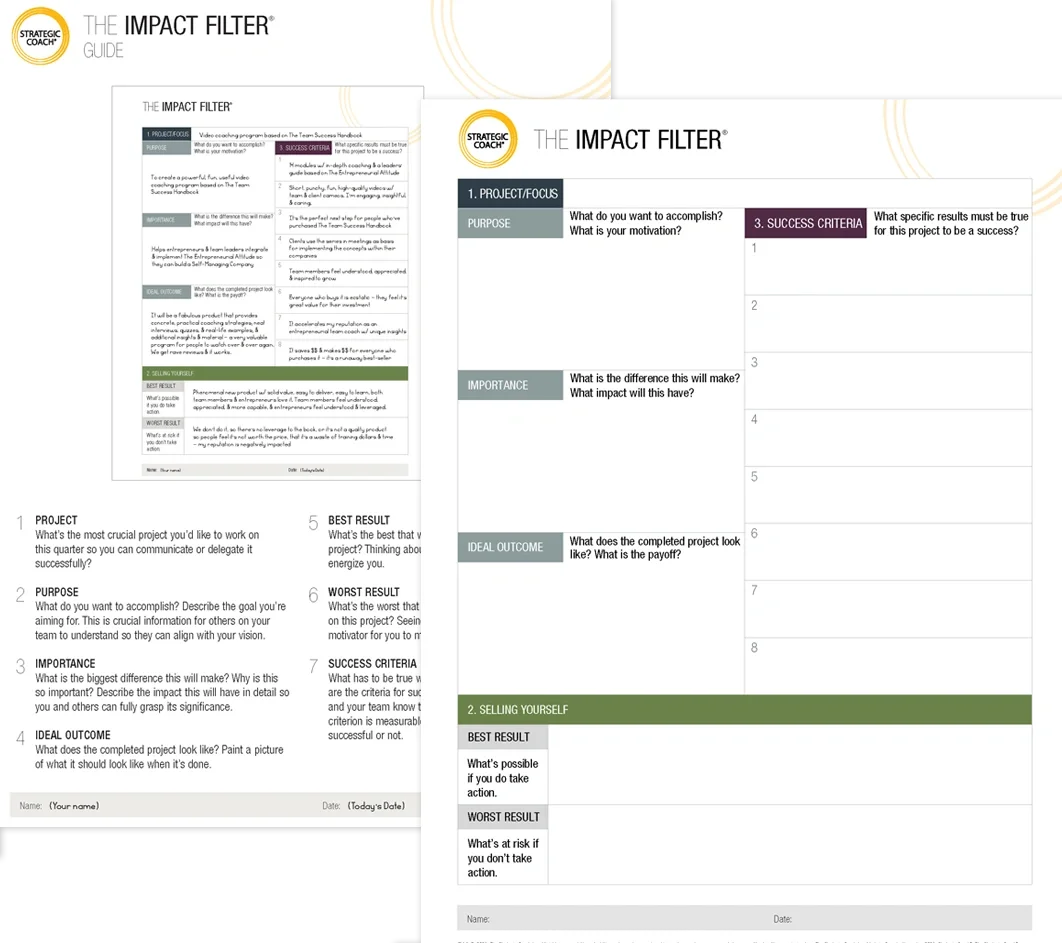
The Impact Filter®
Dan Sullivan’s #1 Thinking Tool
Are you tired of feeling overwhelmed by your goals? The Impact Filter is a powerful planning tool that can help you find clarity and focus. It’s a thinking process that filters out everything except the impact you want to have, and it’s the same tool that Dan Sullivan uses in every meeting.